
Robotic Spray Painting/Coating System
Upgrade your finishing process with our advanced Robotic Spray Painting / Coating System engineered for precision, consistency, and long-term performance. Moreover, reduce material waste, optimize cycle times, and achieve uniform coating thickness across complex components. Partner with Mahajan Automation today to enhance productivity, improve quality standards, and stay ahead in competitive industrial manufacturing.
Robotic Spray Painting / Coating System
A Robotic Spray Painting / Coating System is an advanced automation solution designed to deliver precise, uniform, and high-quality surface finishing across a wide range of industrial applications. By integrating intelligent robotic arms with programmable spray technology, the system ensures consistent coating thickness while significantly reducing material wastage. Moreover, it improves productivity through faster cycle times and repeatable performance, even in high-volume production environments. In addition, automated parameter control enhances finish quality on complex geometries, thereby minimizing rework and operational costs. As a result, manufacturers benefit from improved efficiency, safer working conditions, and superior surface protection that meets stringent industry standards.
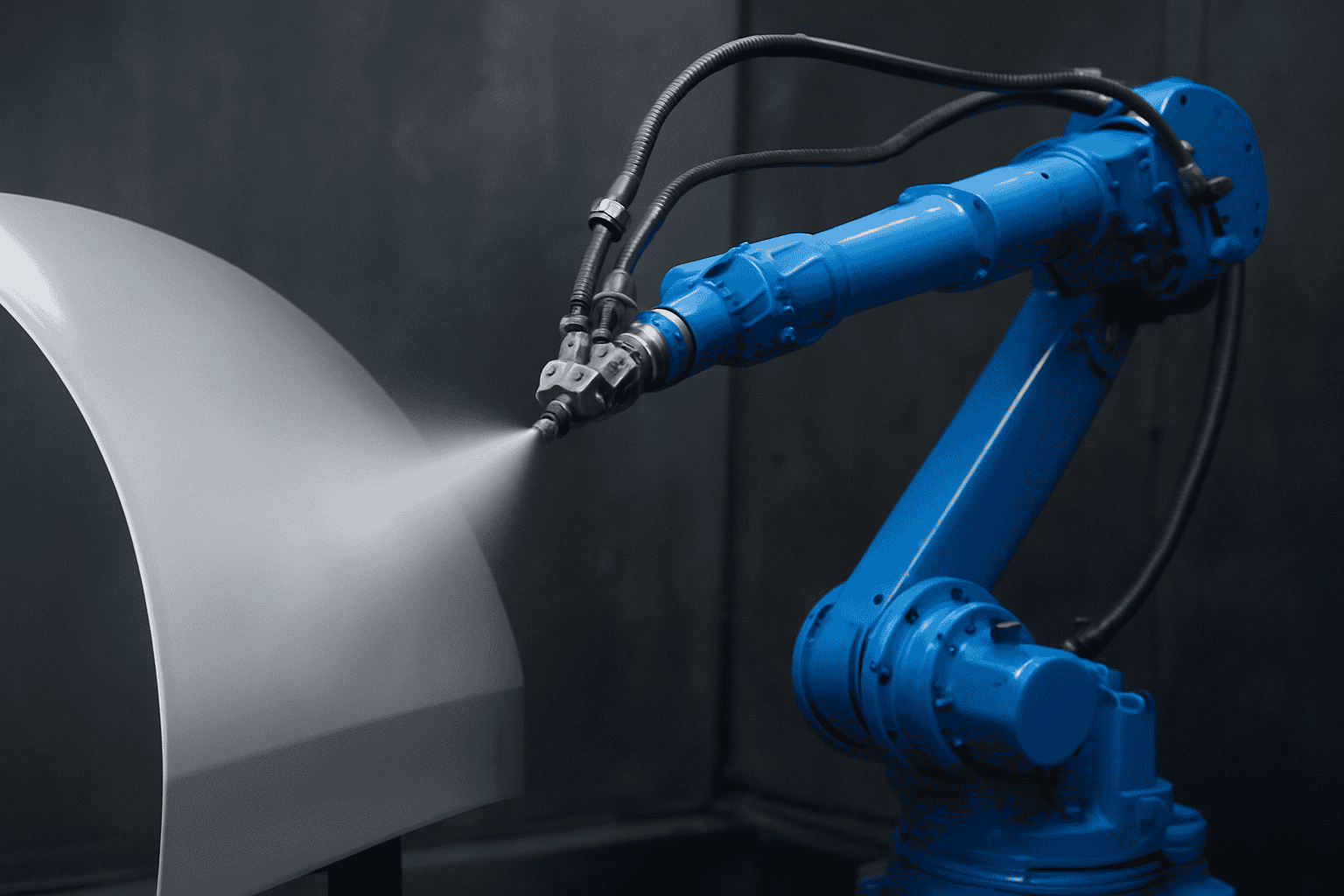
Robotic Spray Painting / Coating System
Spray Painting & Coating Systems is a fully automated surface finishing solution designed to deliver precise, consistent, and high-quality coating results across diverse industrial applications. By integrating advanced robotic arms with intelligent spray control technology, the system ensures uniform paint thickness and smooth coverage, even on complex shapes and intricate components. Moreover, it significantly reduces overspray and material waste, thereby lowering operational costs while improving overall efficiency. In addition, automated programming enables repeatable performance and faster cycle times, which ultimately enhances productivity in high-volume manufacturing environments. As a result, industries such as automotive, heavy engineering, and metal fabrication benefit from superior finish quality, improved workplace safety, and reliable long-term performance.
Types of Liquid Paint Dispensing
Pressure Pot Dispensing System
This system uses compressed air to push liquid paint from a sealed pressure pot to the spray gun. It is widely used for medium- to high-volume applications because it ensures steady paint flow and consistent coating performance.
Pump-Based Dispensing System
Pump systems, such as diaphragm or piston pumps, transfer paint with controlled pressure and flow rate. Moreover, they are ideal for high-viscosity coatings and long-distance material transfer in automated spray setups.
Gravity Feed Dispensing System
In this type, paint flows from a top-mounted cup into the spray gun through gravity. Therefore, it is commonly used for small-scale or precision applications where lower pressure and minimal material usage are required.
Siphon Feed Dispensing System
This system draws paint from a container using air pressure suction. As a result, it is suitable for general-purpose coating applications and moderate production volumes.
Metering Valve Dispensing System
Metering systems precisely control the amount of liquid paint dispensed during each cycle. Consequently, they are ideal for automated robotic spray painting systems that demand accurate and repeatable coating thickness.
Airless Spray Dispensing System
Airless systems use high pressure to atomize paint without compressed air. In addition, they provide excellent coverage, higher transfer efficiency, and reduced overspray, making them suitable for industrial coating applications.
Robotic Spray Painting / Coating Systems Application's
Automotive Industry
Ensures uniform and high-gloss paint application on vehicle bodies and components, thereby improving finish quality, corrosion resistance, and overall production efficiency while reducing rework and material waste.
Heavy Engineering Industry
Provides durable and consistent protective coatings on large machinery parts, thus enhancing wear resistance, preventing corrosion, and significantly extending equipment lifespan in demanding environments.
Infrastructure & Structural Fabrication
Delivers even coating coverage on steel structures, bridges, and fabricated assemblies, ensuring long-term corrosion protection, structural durability, and reduced maintenance costs.
Oil & Gas Industry
Applies high-performance protective coatings on pipelines, storage tanks, and critical components, thereby safeguarding assets against harsh chemicals, extreme temperatures, and corrosive environments.
Railways & Transport
Enhances surface finishing on coaches, wagons, and transport equipment, improving aesthetics, weather resistance, and mechanical durability while ensuring consistent quality in high-volume production.
Shipbuilding & Offshore
Applies marine-grade coatings with precision and consistency, protecting vessels and offshore structures from saltwater corrosion, humidity, and severe environmental conditions.
Benefits of Robotic Spray Painting / Coating Systems
Consistent & High-Quality Finish
Robotic Spray Painting / Coating Systems deliver uniform coating thickness and smooth surface finish across every component. As a result, manufacturers achieve superior product aesthetics, reduced defects, and minimal rework.
Increased Productivity & Faster Cycle Times
Because the system operates with programmed precision and repeatability, it significantly reduces manual intervention. Consequently, production speed increases while maintaining consistent coating quality in high-volume operations.
Reduced Material Waste & Cost Savings
By optimizing spray patterns and controlling paint flow accurately, the system minimizes overspray and material loss. Therefore, companies benefit from improved transfer efficiency and lower operational costs.
Enhanced Workplace Safety
Automation reduces direct human exposure to hazardous fumes, chemicals, and high-pressure spray environments. In addition, it creates a safer and more controlled working environment for operators.
Flexibility for Complex Geometries
Robotic systems can easily handle intricate shapes and hard-to-reach surfaces with precise multi-axis movement. Thus, they ensure complete coverage and consistent performance across diverse industrial applications.
Frequently Asked Questions FAQ
What is a Robotic Spray Painting / Coating System?
A Robotic Spray Painting / Coating System is an automated solution that uses programmable robotic arms to apply paint or protective coatings with high precision. As a result, it ensures uniform coverage, reduced waste, and consistent finish quality in industrial applications.
How does a robotic coating system improve production efficiency?
Because the system operates with programmed accuracy and repeatability, it minimizes manual errors and reduces cycle times. Consequently, manufacturers achieve higher productivity, faster turnaround, and consistent output in high-volume production.
Which industries benefit from robotic spray painting systems?
Industries such as automotive, heavy engineering, infrastructure, oil & gas, railways, and shipbuilding benefit significantly. Moreover, these systems are ideal for any sector that requires durable, high-quality surface finishing.
Can robotic spray systems handle complex shapes and large components?
Yes, robotic systems are designed with multi-axis movement, allowing them to coat intricate geometries and large surfaces efficiently. Therefore, they ensure complete and uniform coverage even in challenging applications.
How does a robotic spray painting system reduce material waste?
By precisely controlling spray patterns, paint flow, and pressure, the system reduces overspray and excess coating usage. As a result, companies experience better transfer efficiency and lower material costs.