
Robotic Foundry System
Looking for Robotic Forging System that deliver exceptional strength, durability, and precision for demanding industrial applications? Our advanced forging capabilities ensure high-performance components with superior grain structure, excellent mechanical properties, and long-lasting reliability. Whether you need custom-forged parts for automotive, aerospace, heavy machinery, or energy applications, we provide consistent quality, tight tolerances, and efficient production timelines.
Ready to build stronger, high-precision components? Contact us today and experience the power of professional forging—strength and performance start here.
Robotic Foundry System
Robotic Foundry System deliver high-strength, precision-driven metal forming solutions using fully automated robotic systems for industries such as automotive, aerospace, defense, heavy machinery, railway, and industrial fabrication. With advanced motion control, high-force mechanical manipulation, and intelligent temperature and tooling integration, robotic forging ensures consistent shaping of metals like steel, aluminum, titanium, brass, and alloy components with superior accuracy and repeatability. This automation reduces human fatigue, improves process safety, and ensures uniform deformation, tight tolerances, and exceptional structural integrity. Ideal for high-volume production and complex part geometries, robotic forging enhances productivity, reduces waste, and delivers durable, high-performance forged components built to withstand extreme operational conditions.
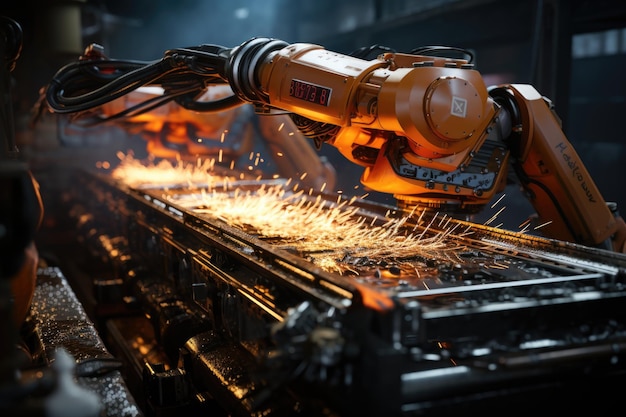
Robotic Foundry Technology
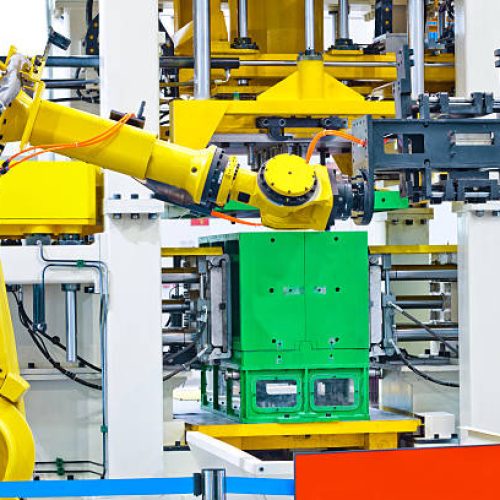
Robotic metal forging technology integrates advanced industrial robots with high-precision forming equipment to reshape metal components efficiently without material loss. These automated systems handle tasks such as bending, stamping, rolling, and deep drawing with exceptional accuracy and repeatability. Robots streamline material feeding and positioning, ensuring consistent force application and minimizing production errors. Equipped with smart sensors and programmable controls, robotic forming systems continuously monitor pressure, alignment, and temperature to maintain superior quality standards.
Automation significantly enhances workplace safety by reducing manual handling of heavy sheets and components. Robotic arms can operate at high speeds while maintaining tight tolerances, making them ideal for large-scale manufacturing environments. The technology also supports flexible production, allowing quick adjustments for different shapes and batch sizes. By improving material utilization and reducing waste, robotic forming lowers operational costs while boosting productivity. Widely used in automotive, aerospace, construction, and heavy engineering industries, robotic metal forming delivers strong, durable, and dimensionally accurate parts essential for modern manufacturing.
Robotic Intelligent Automation in Robotic Foundry Systems
Billet Handling & Feeding
Robots pick raw billets and load them into conveyors, furnaces, or induction heaters for a smooth and continuous production flow.
Hot Billet Extraction from Furnace
Heat-resistant robotic arms safely remove red-hot billets, improving worker safety and operational efficiency.
Press Tending & Loading into Forging Press
Robots accurately transfer heated billets into forging presses with precise positioning for consistent shaping.
Inter-Press Part Transfer
Automated systems quickly move hot components between multiple forging stages to reduce cycle time.
Forged Part Removal
Robots extract finished parts from the press efficiently, ensuring uninterrupted production.
Trimming Press Loading & Flash Removal Handling
Robots load forged parts into trimming presses and remove excess flash for cleaner finishes.
Hot Part Cooling Line Automation
Automated robots place forged components into controlled cooling systems to maintain material integrity.
Robotic Forging Manipulators
Heavy-duty manipulators rotate, orient, and reposition large heated components with high precision.
Robotic Grinding & Deburring
Robots perform finishing operations to enhance surface quality and achieve dimensional accuracy.
Automated Inspection (Vision + Sensors)
Automated cleaning removes scale, dust, and impurities, preparing parts for inspection or assembly.
Mixed-Batch & Flexible Forging Cell Automation
Smart cameras and sensors measure dimensions and detect defects to maintain strict quality standards.
Material Sorting & Palletizing
Multi-robot cells handle different part types with quick tool changeovers for flexible manufacturing.
Robotic Foundry Application's
Automotive Body & Chassis Welding
Robotic laser welding is widely used in automotive manufacturing for body panels and chassis parts. It delivers high-speed, precise welds with minimal distortion, ensuring strong and lightweight vehicle structures.
Precision Sheet Metal Fabrication
Laser welding is ideal for thin and complex sheet metal components. It provides clean, accurate welds with excellent finish, reducing the need for post-processing.
Aerospace & Aviation Components
TIG welding is preferred in aerospace industries for its superior precision and clean weld quality. It is ideal for critical components where strength and accuracy are essential.
Precision Sheet Metal Fabrication
TIG welding is commonly used for stainless steel and aluminum parts. It produces smooth, high-quality welds with excellent control and minimal contamination.
Heavy Structural & Industrial Fabrication
MIG welding is widely used for welding thick materials and structural components. Its high deposition rate ensures strong joints and faster production.
Automotive & Mass Production Welding
MIG welding supports high-volume manufacturing with consistent weld quality. It is efficient, cost-effective, and suitable for repetitive welding tasks.
Benefits of Robotic Foundry System
High Precision & Dimensional Consistency
Robotic forging ensures uniform force application and precise part handling, resulting in consistent product dimensions, improved accuracy, and repeatable quality across every production batch.
Increased Productivity & Continuous Operation
Automation enables continuous forging cycles with fast part handling and reduced downtime. Robots can work 24/7 without fatigue, significantly accelerating production output and improving operational efficiency.
Enhanced Worker Safety
Forging environments involve extreme heat, high force, and heavy components. Robotic systems remove operators from hazardous zones, reducing risks of burns, crushing injuries, and long-term repetitive strain.
Lower Production Costs & Reduced Scrap
With optimized part placement and controlled forging parameters, robotic forging reduces material waste, tooling wear, and rework costs. This leads to maximum metal utilization and improved ROI.
Versatility Across Materials & Applications
Robotic forging supports a wide range of metals—such as steel, aluminum, titanium, brass, alloys, and nickel-based materials—making it suitable for industries like automotive, aerospace, railways, defense, and heavy machinery.