
Turnkey Robotic Welding Automation Solutions in India
Transforming Manufacturing with Intelligent Robotic
Welding Automation
Mahajan Automation Pvt. Ltd. is a leading robotic welding automation company in India, providing turnkey solutions from design and engineering to manufacturing, installation, commissioning, and after-sales support. With 3,000+ successful robotic projects, we deliver customized welding cells that improve productivity, weld quality, consistency, and production efficiency while reducing cycle time, defects, and costs.
Complete Turnkey Robotic Welding Solutions
Mahajan Automation provides complete turnkey robotic welding solutions, covering everything from feasibility studies, process development, fixture design, robotic simulation, and system engineering to installation, commissioning, programming, and operator training. Our team ensures seamless integration with existing production lines while delivering customized automation based on your welding requirements, cycle time, and production goals. We also provide ongoing production support, preventive maintenance, and AMC services to ensure reliable long-term performance. From a single robotic welding cell to a fully automated manufacturing line, our solutions are designed to improve weld quality, productivity, consistency, and overall manufacturing efficiency.
Complete Robotic Automation Capabilities
Multi-Brand Industrial Robot Integration
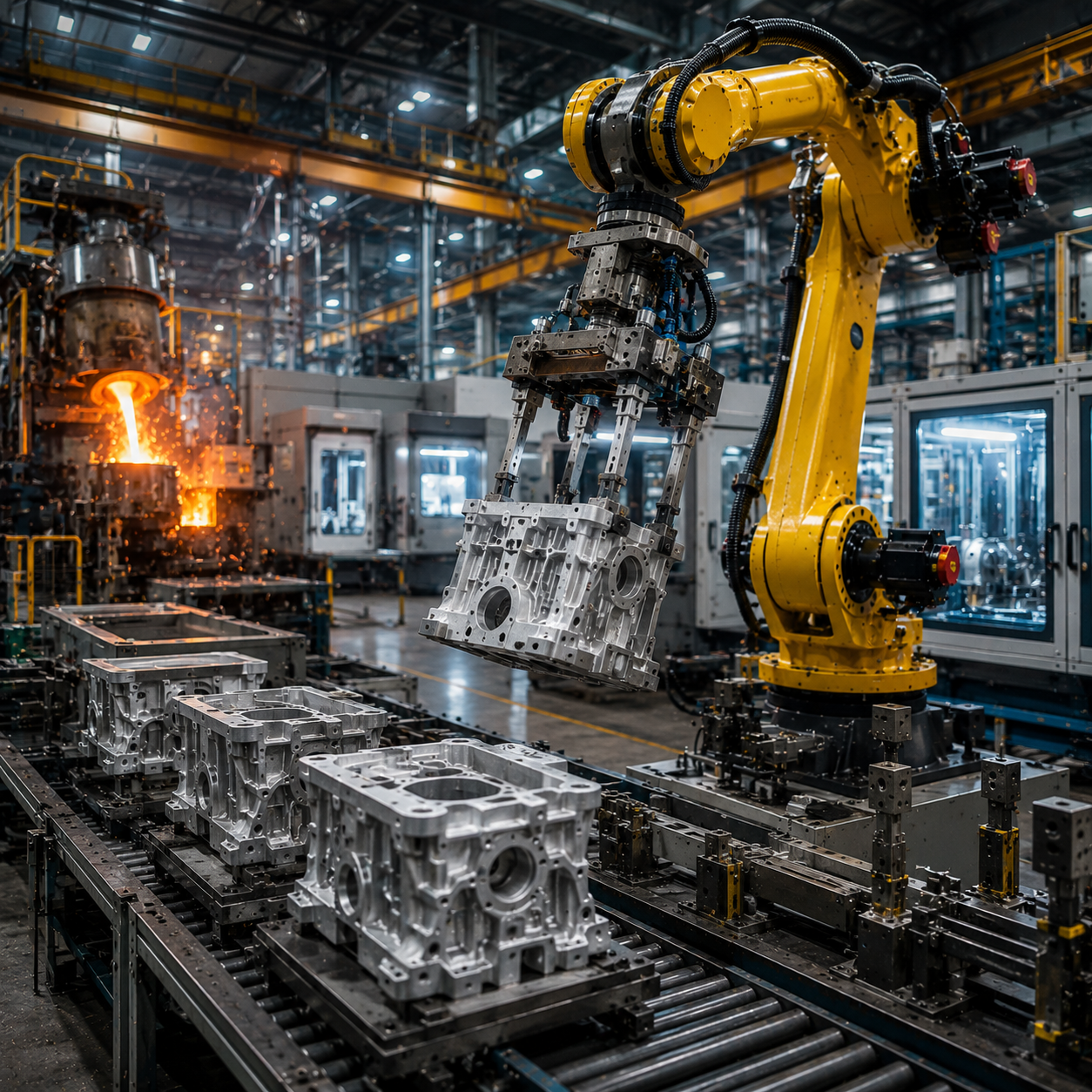
Mahajan Automation provides multi-brand industrial robot integration, giving manufacturers the flexibility to choose the right robotic platform for their specific welding and automation requirements. As an independent system integrator, we work with leading brands including FANUC, ABB, KUKA, Yaskawa Motoman, and Kawasaki Robotics. Our engineering team evaluates factors such as payload, reach, accuracy, duty cycle, production volume, and application complexity to recommend and integrate the most suitable robot. This brand-independent approach helps customers achieve reliable, scalable, and cost-effective robotic automation without being limited to a single robot manufacturer.
In-House Engineering & Design Excellence
Mahajan Automation has a dedicated in-house engineering team of 10+ experienced automation professionals. Our expertise covers robotic cell design, mechanical systems, conveyors, EOAT, grippers, servo positioners, and safety systems. We also specialize in vision-guided robotics, PLC, and SCADA integration for complete automation solutions. Every system is custom-engineered to maximize productivity, minimize downtime, and ensure long-term reliability.
Advanced Robotic Welding Cutting Solutions Technology
Metal Inert Gas Welding (MIG) is a high-efficiency arc welding process that uses a continuously fed consumable wire electrode and shielding gas to create strong, clean, and precise welds. Known for its fast deposition rate and ease of automation, MIG welding is widely used in automotive manufacturing, structural steel fabrication, sheet metal work, heavy machinery production, and robotic welding lines where speed, consistency, and productivity are critical.
Tungsten Inert Gas Welding (TIG)is a precision arc welding process that uses a non-consumable tungsten electrode and inert shielding gas to produce high-quality, clean, and controlled welds. Known for superior finish and strong weld integrity, TIG welding is ideal for thin materials and critical applications such as aerospace components, stainless steel fabrication, pressure vessels, pipelines, and automotive parts where accuracy and appearance are essential.
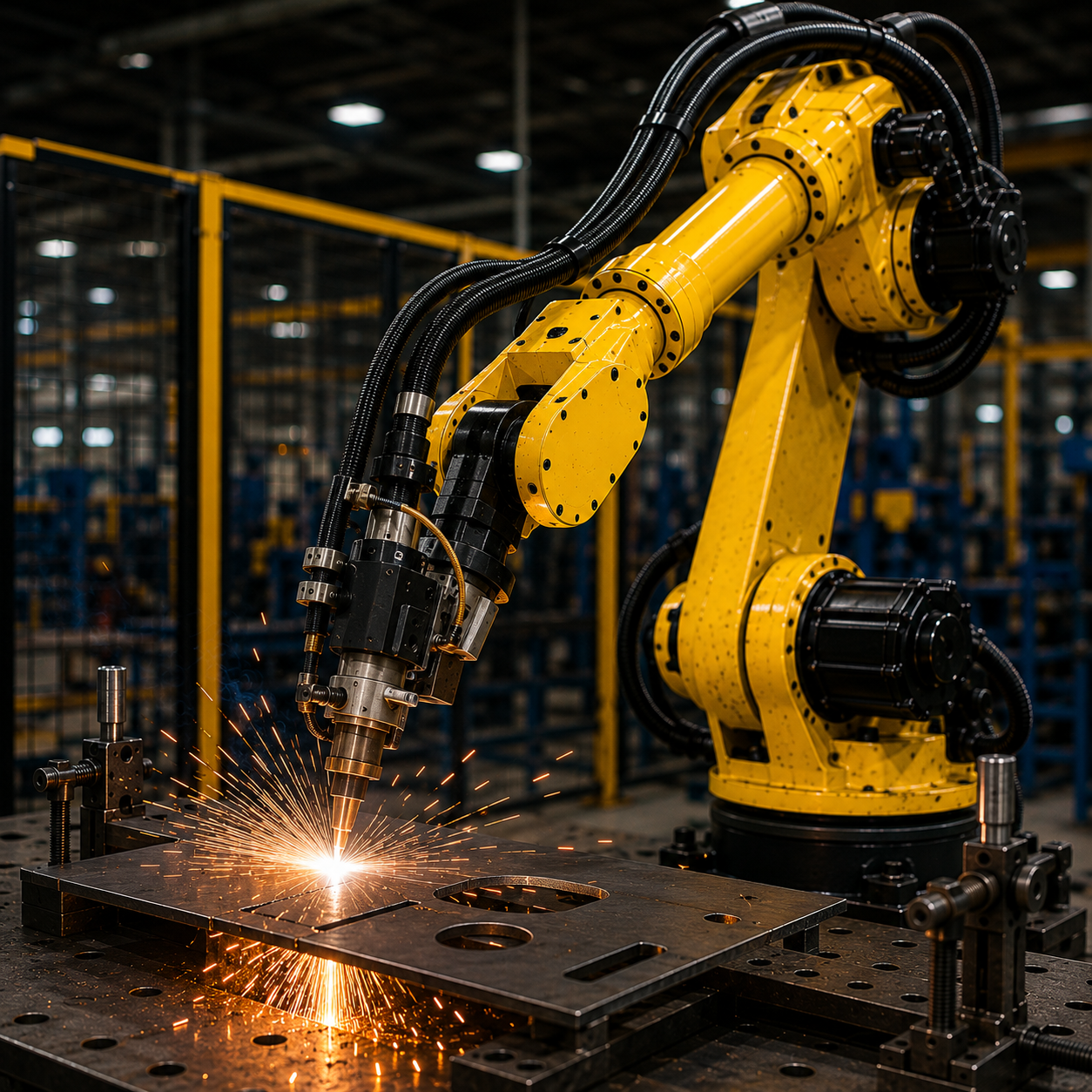
Robot Laser Welding (LW) is an advanced automated welding process that uses a high-powered laser beam integrated with a robotic system to create precise, deep-penetration welds with minimal heat distortion. It delivers high-speed, repeatable, and clean welding results, making it ideal for automotive body structures, EV battery components, sheet metal assemblies, electronics housings, and precision engineering applications where accuracy, strength, and production efficiency are critical.
Robotic Laser Cutting is a high-precision automated cutting process that uses a focused laser beam and industrial robotic systems to produce clean, accurate, and complex cuts with exceptional speed and repeatability. Known for its minimal material waste, superior edge quality, and high production efficiency, robotic laser cutting is widely used in automotive manufacturing, sheet metal fabrication, aerospace, electrical enclosures, heavy engineering, and industrial manufacturing where precision, flexibility, and consistent cutting performance are essential.
Robotic Plasma Cutting is a high-performance thermal cutting process that uses a high-velocity jet of ionized gas (plasma) and industrial robotic systems to deliver fast, accurate, and efficient cutting of electrically conductive metals. Known for its high cutting speed, excellent edge quality, and ability to process thick materials, robotic plasma cutting is widely used in structural steel fabrication, automotive manufacturing, heavy engineering, shipbuilding, and industrial metal fabrication where productivity, precision, and repeatable cutting performance are essential.
Robotic Waterjet Cutting is a precision cold-cutting process that uses a high-pressure stream of water, with or without abrasive media, and industrial robotic systems to cut a wide range of materials with exceptional accuracy. Known for its clean edges, no heat-affected zone, and minimal material distortion, robotic waterjet cutting is widely used in aerospace, automotive manufacturing, metal fabrication, glass processing, stone cutting, and composite material applications where precision, flexibility, and superior cutting quality are essential.
Robotic Metal Inert Gas Welding (MIG)
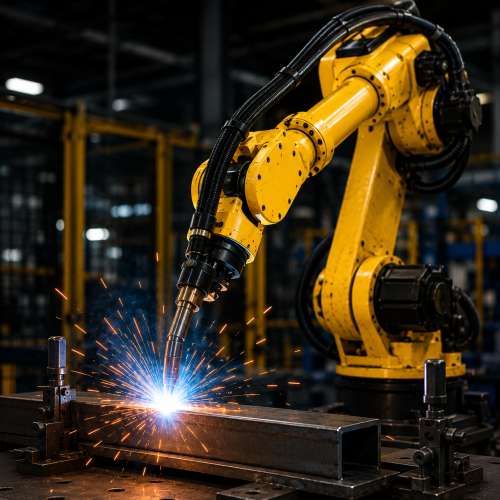
Robotic Metal Inert Gas Welding (MIG) is an automated welding solution widely used in industries that demand high-speed production, strong weld integrity, and consistent quality. By combining industrial robotic arms with the MIG process, manufacturers achieve stable arc performance, uniform penetration, and repeatable weld beads with minimal manual intervention. This significantly reduces defects, improves cycle time, and enhances overall productivity.
In the automotive sector, robotic MIG welding is applied in chassis assemblies, body structures, and structural reinforcements. Heavy engineering and industrial equipment manufacturers use it for machinery frames, construction equipment, and agricultural implements requiring high-strength joints. In infrastructure and structural fabrication, it supports beams, columns, and steel assemblies, ensuring compliance with safety standards. Railways and transport industries rely on robotic MIG systems for wagon frames and load-bearing components.
Overall, robotic MIG welding improves efficiency, reduces operational costs, enhances workplace safety, and delivers reliable, high-quality welds in modern automated manufacturing environments.
Robotic Tungsten Inert Gas Welding (TIG)
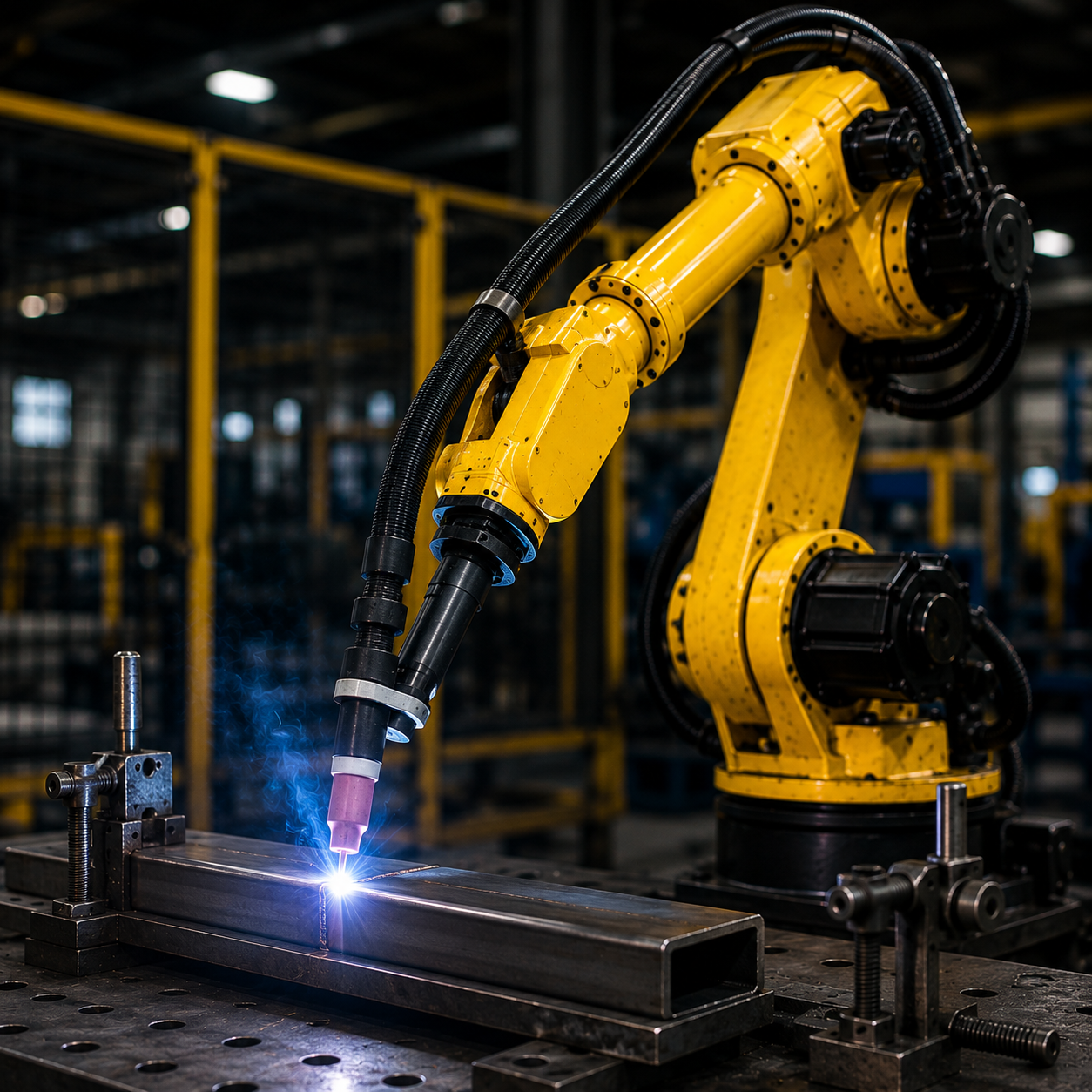
Robotic Tungsten Inert Gas Welding (TIG) is a precision-driven automated welding solution used in industries that require superior weld quality, clean finishes, and controlled heat input. By integrating industrial robotic arms with the TIG process, manufacturers achieve exceptional arc stability, accurate torch positioning, and consistent weld penetration with minimal distortion. This makes it ideal for thin materials and applications where appearance and structural integrity are critical.
In the automotive and EV sectors, robotic TIG welding is used for battery enclosures, exhaust components, and lightweight structural assemblies. Aerospace and defense industries rely on it for high-precision components and critical joints. In stainless steel and food-grade fabrication, it ensures hygienic, contamination-free welds for tanks, pipelines, and processing equipment. The oil and gas industry also utilizes robotic TIG for pressure vessels and high-performance piping systems.
Overall, robotic TIG welding enhances precision, improves repeatability, reduces defects, and delivers premium-quality welds in advanced manufacturing environments.
Robotic Laser Welding System
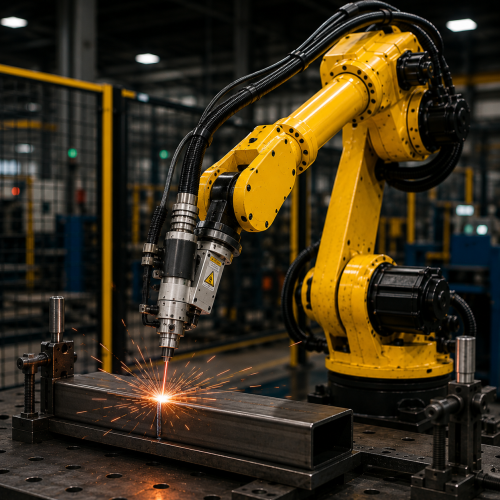
Robotic Laser Welding System is an advanced automated welding solution designed for high-speed, high-precision manufacturing environments. By integrating industrial robotic arms with high-powered laser technology, the system delivers deep-penetration welds with minimal heat input, low distortion, and exceptional accuracy. The focused laser beam enables precise energy control, making it ideal for complex geometries and thin to medium-thickness materials where dimensional stability is critical.
In the automotive and electric vehicle sectors, robotic laser welding is widely used for body-in-white assemblies, battery modules, transmission components, and lightweight structural parts. Electronics and precision engineering industries apply it for sensor housings, enclosures, and fine assemblies requiring clean, narrow weld seams. In heavy fabrication and industrial manufacturing, it supports high-speed production lines with consistent weld quality and reduced cycle times.
Overall, robotic laser welding systems enhance productivity, improve joint strength, reduce post-processing requirements, and deliver repeatable, high-quality welds in modern automated manufacturing facilities.
Robotic Welding Cutting Solutions Applications

Automotive Industry
Robotic welding and automation solutions for automotive components, assemblies, and high-volume production, improving weld consistency, throughput, and manufacturing efficiency.

Electric Vehicle (EV) Industry
Advanced robotic automation for EV components and assemblies, supporting precise welding, repeatable processes, and scalable electric vehicle manufacturing.

Medical Equipment
Precision-focused robotic welding solutions for medical equipment and components, helping manufacturers achieve consistent weld quality and reliable production standards.
Battery Manufacturing
Robotic automation solutions for battery manufacturing and related components, enabling controlled, repeatable welding processes with improved productivity and process consistency.
Electronics Manufacturing
Compact and precise robotic automation for electronic components and assemblies, designed to support accurate, repeatable, and efficient manufacturing processes.
Precision Engineering
Customized robotic welding and automation systems for precision-engineered components, delivering high accuracy, consistent quality, and reduced production cycle times.
Benefits of Robotic Welding Cutting Solutions
Consistent Weld Quality
Automated torch positioning and controlled parameters ensure uniform penetration, stable arc performance, and defect-free weld seams.
Precision Cutting Accuracy
Laser, plasma, or robotic cutting systems provide clean edges, tight tolerances, and minimal material distortion.
Reduced Human Error:
Automation eliminates variability caused by manual welding, improving overall product reliability.
Superior Surface Finish
Controlled heat input minimizes spatter, warping, and post-processing requirements.
Enhanced Structural Integrity
Optimized welding parameters improve joint strength, fatigue resistance, and long-term durability.
Frequently Asked Questions FAQ
What are Robotic Welding Cutting Solutions?
Robotic MIG Welding (Metal Inert Gas) is an automated welding process where a robot arm performs welding using a continuously fed wire electrode and shielding gas. It is widely used in automotive, heavy fabrication, construction equipment, and structural manufacturing due to its high speed and productivity.
Which industries use Robotic Welding Cutting Solutions?
Robotic TIG Welding (Tungsten Inert Gas) uses a non-consumable tungsten electrode to produce precise and clean welds. It is ideal for thin materials, stainless steel, aluminum, and applications that require high-quality finishing such as aerospace, medical equipment, and precision components.
What are the advantages of Robotic Laser Welding?
Robotic Laser Welding uses a high-powered laser beam to join materials with extreme accuracy. It offers deep penetration, minimal heat distortion, high-speed production, and is perfect for complex and delicate components in automotive and electronics industries.
How do I choose between Robotic MIG, TIG, and Laser Welding?
The choice depends on:
Material type & thickness
Production speed requirements
Weld appearance & precision needs
Budget & automation level
MIG is best for speed, TIG for precision, and Laser for advanced high-speed, low-distortion applications.
Is robotic welding better than manual welding?
Yes. Robotic welding provides consistent weld quality, higher production speed, reduced human error, improved safety, and long-term cost savings. It is ideal for repetitive and high-volume manufacturing operations.