
Robotic Laser Welding System
Upgrade your production with our Robotic Laser Welding System — engineered for precision, speed, and flawless weld quality. Contact us today to enhance accuracy, reduce heat distortion, minimize rework, and accelerate your manufacturing performance with advanced, high-speed laser automation solutions. Experience superior consistency, improved energy efficiency, and seamless integration into your existing production line for long-term operational excellence.
Robotic Laser Welding System
A Robotic Water Jet Cutting System is an advanced manufacturing solution that combines high-pressure water jet technology with industrial robotics to automate the cutting process. By using a concentrated stream of water, often mixed with abrasive particles, the system can accurately cut a wide range of materials, including metals, composites, stone, glass, rubber, and engineered plastics. The integration of robotics enables precise movement and positioning, allowing manufacturers to process complex shapes, contours, and three-dimensional components with exceptional accuracy.
Unlike conventional cutting methods, robotic water jet cutting is a cold-cutting process that does not generate heat during operation. This eliminates the risk of heat-affected zones (HAZ), material distortion, and surface damage, helping preserve the original properties of the material. As a result, it is widely used in applications where dimensional accuracy, clean edge quality, and material integrity are critical.
As part of modern robotic cutting automation solutions, these systems can be integrated into automated production lines to improve productivity, reduce manual intervention, and ensure consistent cutting performance. Their flexibility and precision make them ideal for industries such as automotive, aerospace, heavy engineering, metal fabrication, and defence manufacturing, where high-quality material processing is essential.
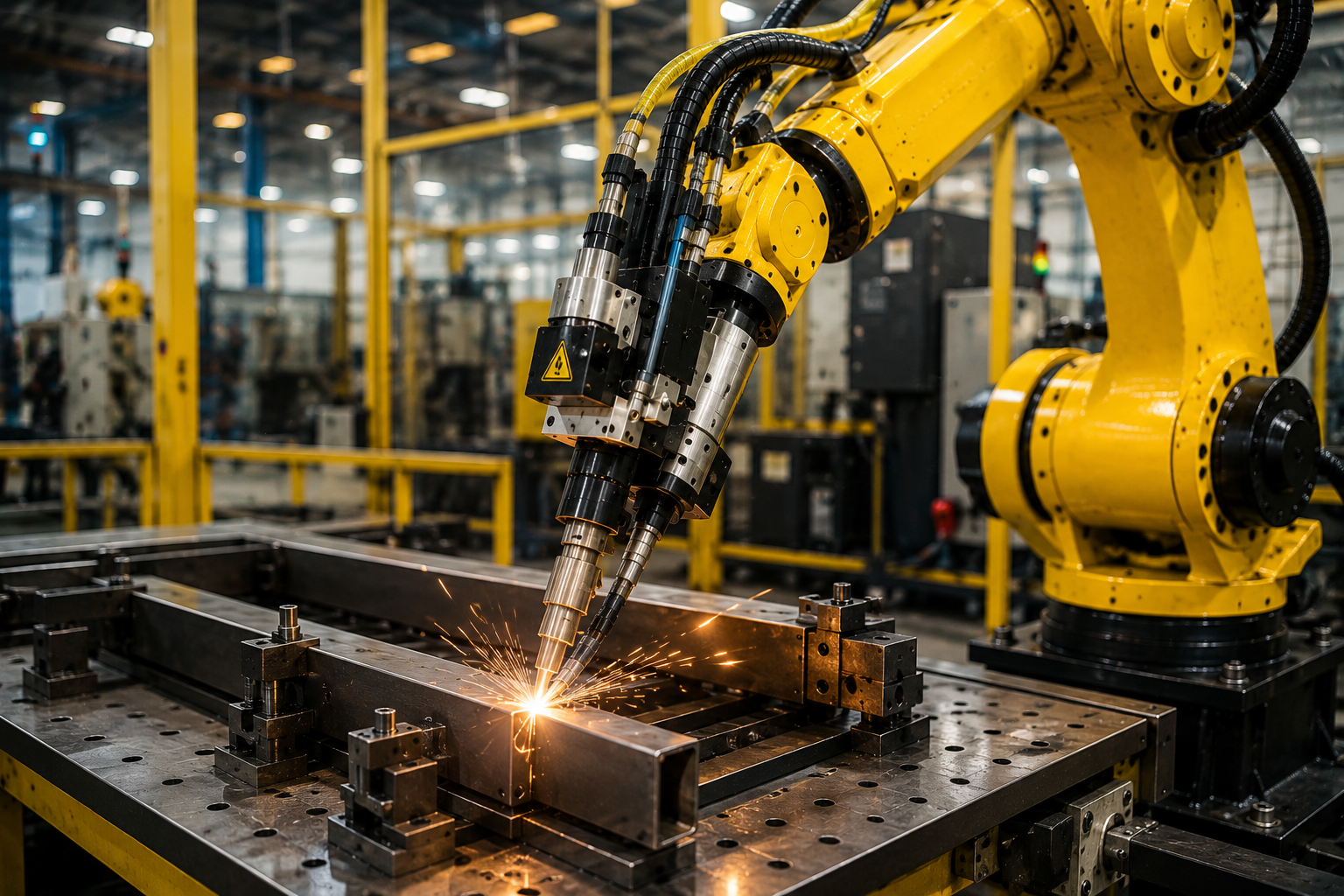
How Does a Robotic Water Jet Cutting System Work?
A robotic water jet cutting system operates by pressurizing water to extremely high levels and directing it through a specialized cutting nozzle. The robotic arm guides the nozzle along programmed cutting paths, enabling accurate trimming, contour cutting, and three-dimensional material processing. For harder materials, abrasive particles are added to increase cutting power and efficiency. Since the process is a cold-cutting technology, it eliminates heat-affected zones, reduces material distortion, and ensures consistent cutting performance across complex manufacturing applications.
Robotic Laser Welding System
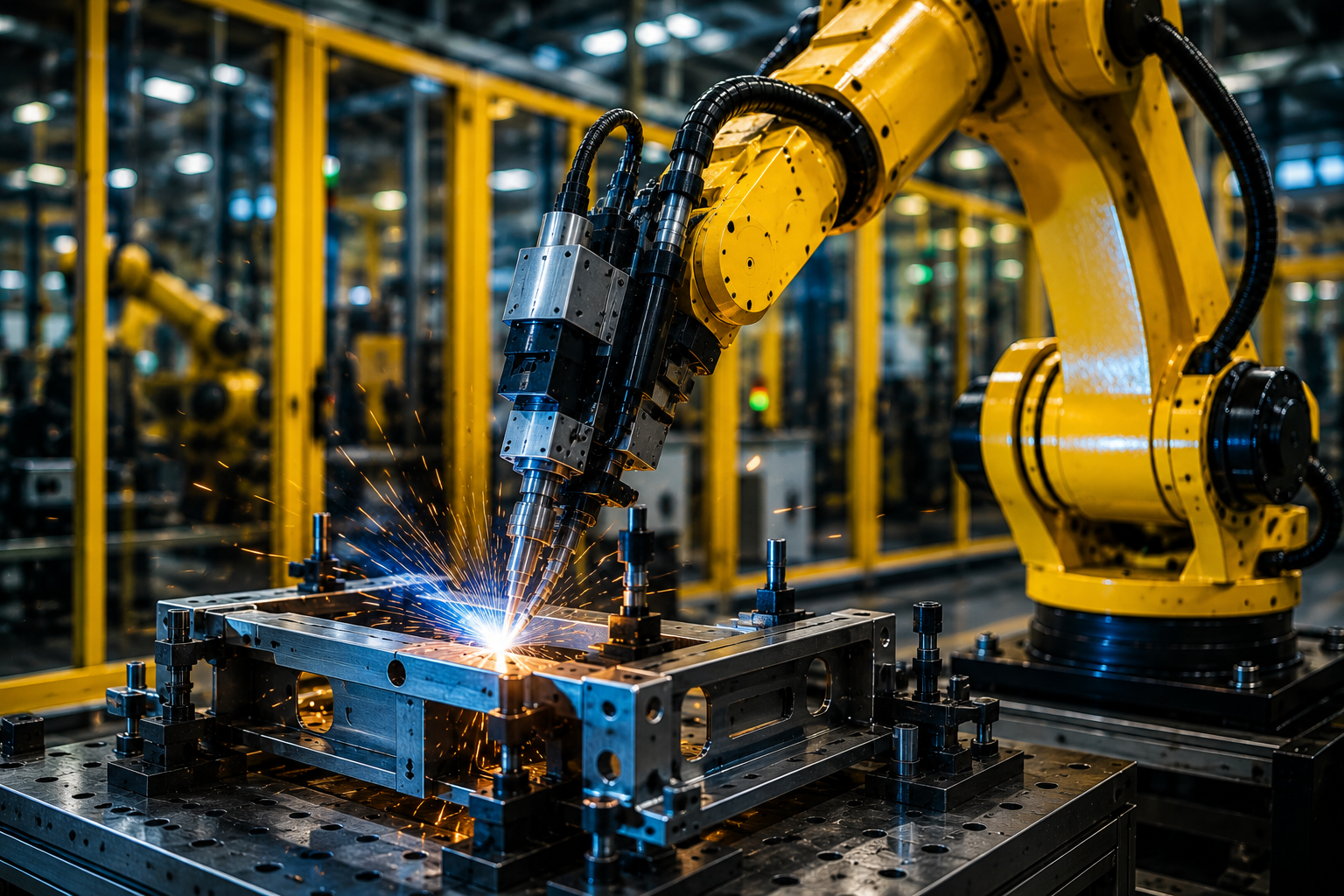
Why Choose Robotic Laser Welding Automation?
High Precision & Low Distortion
The focused laser beam delivers accurate weld placement with minimal heat impact, reducing material deformation.
Faster Production Speed
Robotic automation enables high-speed welding cycles, increasing overall manufacturing output.
Consistent & Reliable Quality
Automated parameter control ensures uniform weld strength and repeatable results in every production cycle.
A Robotic Laser Welding System uses high-precision laser technology and robotic automation to deliver fast, accurate, and low-distortion welding for modern industrial applications.
A Robotic Laser Welding System combines advanced laser beam technology with programmable robotic automation to achieve exceptional welding precision and speed. The focused laser generates deep, narrow welds with minimal heat input, which significantly reduces distortion and improves overall weld quality. Moreover, the system ensures consistent performance across high-volume production runs, making it ideal for industries such as automotive, electronics, medical devices, and precision engineering. With automated control of welding parameters and accurate beam positioning, manufacturers can achieve cleaner welds, reduced rework, and enhanced structural integrity. As a result, businesses benefit from improved productivity, optimized material usage, and long-term operational efficiency while maintaining strict quality standards.
In addition, robotic laser welding supports complex joint designs and intricate components that require extreme accuracy and repeatability. The integration of intelligent sensors and real-time monitoring further enhances process stability and quality assurance. Furthermore, the system allows seamless integration into automated production lines, improving workflow coordination and reducing downtime. Consequently, manufacturers can meet demanding production targets while maintaining consistent performance, cost efficiency, and superior finishing standards.
Robotic Laser Welding System Applications

Automotive Industry
Robotic laser welding is extensively used in the automotive industry for body panels, chassis components, transmission assemblies, EV battery housings, and structural parts. Its high-speed operation and precision welding capabilities help manufacturers achieve stronger joints, reduced heat distortion, and consistent quality across large-scale production lines.

Heavy Engineering Industry
In heavy engineering applications, robotic laser welding provides deep penetration welding and exceptional accuracy for machinery components, industrial equipment, fabricated structures, and heavy-duty assemblies. The process enhances structural integrity while reducing rework and improving production efficiency.

Infrastructure & Structural Fabrication
Robotic laser welding supports the fabrication of steel structures, beams, columns, bridges, and prefabricated construction components. The technology ensures precise weld alignment, improved joint strength, and minimal material distortion, making it ideal for large-scale structural projects.

Oil & Gas Industry
The oil and gas sector utilizes robotic laser welding for pipelines, pressure vessels, storage tanks, heat exchangers, and critical processing equipment. Its ability to create strong, leak-proof welds with high repeatability helps maintain safety, reliability, and operational performance in demanding environments.

Railways & Transport
In railway and transportation manufacturing, robotic laser welding is used for coach bodies, railcar frames, bogie components, cargo containers, and transport equipment. The process delivers high-strength welds, improved dimensional accuracy, and enhanced durability for long-term operational reliability.

Shipbuilding & Offshore
Robotic laser welding plays a vital role in shipbuilding and offshore fabrication by enabling precise joining of marine structures, deck components, bulkheads, and offshore platform equipment. Its ability to produce corrosion-resistant, high-strength welds helps withstand harsh marine environments while improving fabrication efficiency.
Benefits of Robotic Laser Welding System
Exceptional Precision & Accuracy
The focused laser beam ensures highly accurate weld placement with tight tolerances, making it ideal for complex and delicate components.
Minimal Heat Distortion
Low heat input reduces warping and material deformation, resulting in cleaner welds and improved dimensional stability.
High-Speed Production
Robotic automation enables faster welding cycles, significantly increasing manufacturing output and overall efficiency.
Superior Weld Strength
Laser welding delivers deep penetration and strong, durable joints that meet strict industrial quality standards.
Reduced Rework & Operational Costs
Consistent automation minimizes defects, lowers material waste, and reduces post-weld finishing, leading to long-term cost savings.
Frequently Asked Questions FAQ
What is a Robotic Laser Welding System?
A Robotic Laser Welding System is an automated solution that uses a high-intensity laser beam controlled by a robotic arm to create precise, strong, and low-distortion welds.
How is laser welding different from traditional welding?
Laser welding uses a focused laser beam for deep penetration with minimal heat input, whereas traditional welding methods generate higher heat and may cause more distortion.
Which industries use robotic laser welding?
Industries such as automotive, electronics, heavy engineering, oil & gas, railways, and shipbuilding widely use robotic laser welding for precision and high-speed production.
What are the advantages of robotic laser welding?
It offers high accuracy, faster production speed, minimal distortion, reduced rework, and consistent weld quality across large production volumes.
Is robotic laser welding suitable for thin materials?
Yes, the controlled heat input makes it ideal for thin and delicate materials while maintaining strong weld integrity and clean finish.