
Robotic Fettling System
Upgrade your manufacturing process with advanced Industrial Robotic Fettling Systems designed for precise grinding, deburring, and surface finishing of cast components. These automated solutions enhance productivity, ensure consistent quality, reduce manual effort, and improve workplace safety. Achieve faster, smarter, and cost-effective casting operations with robotic fettling automation.
Smart Robotic Fettling Automation for Industrial Manufacturing
Robotic Fettling System is an advanced industrial automation solution designed to improve the precision, consistency, and efficiency of casting finishing operations. By integrating robotic arms with grinding, deburring, and surface finishing tools, manufacturers can automate the removal of excess material, flash, and gates from cast components while maintaining consistent quality. The system accurately processes complex castings with minimal manual intervention, ensuring uniform finishing across every part.
In addition to increasing productivity, Robotic Fettling System automation enhances workplace safety by reducing operator exposure to dust, sparks, vibration, noise, and heavy cast components. Modern systems can integrate machine vision, force sensors, programmable controls, and industrial automation technologies to optimize finishing processes and deliver repeatable results. Manufacturers benefit from faster production cycles, improved surface quality, reduced operating costs, and higher efficiency across foundry and metal casting applications.
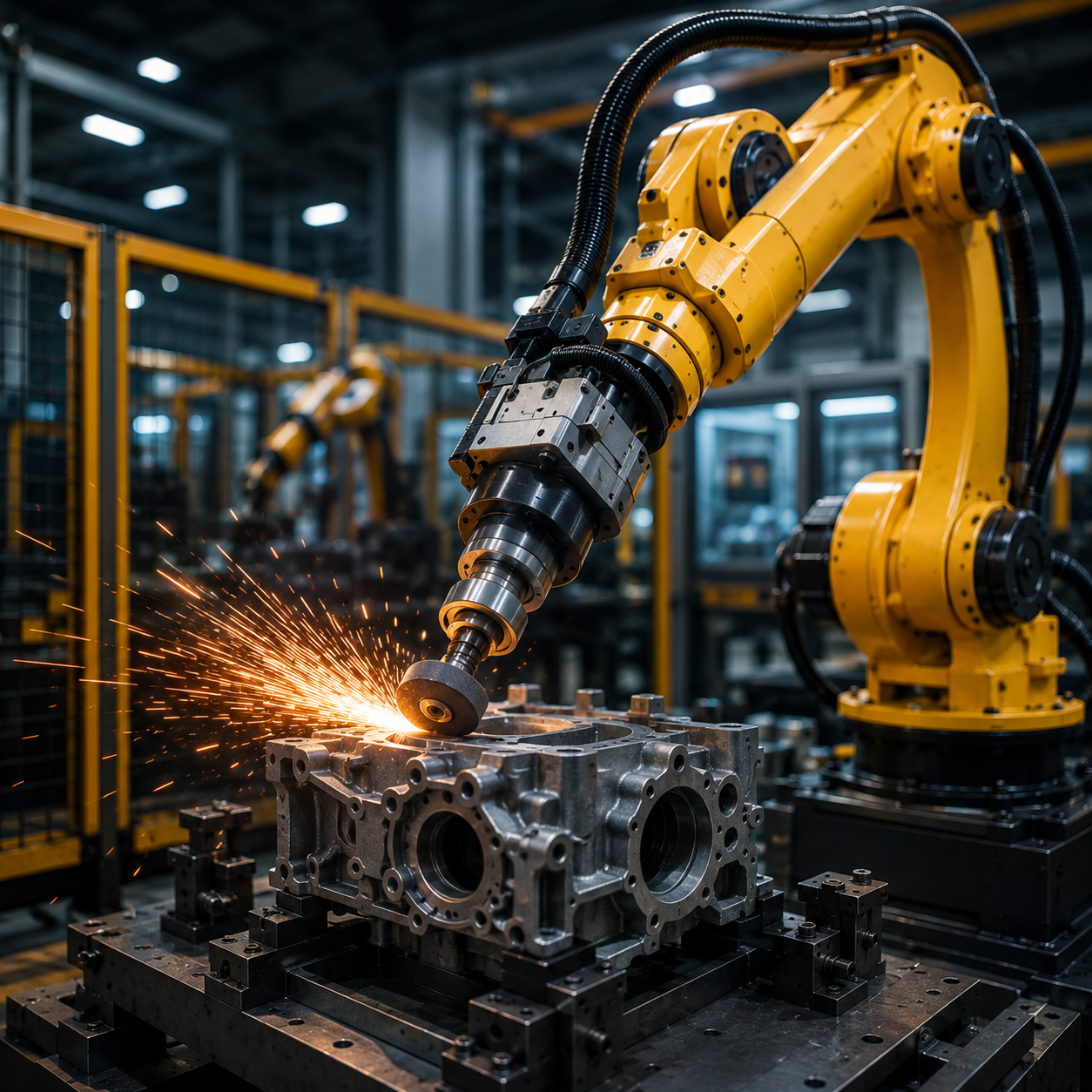
What is a Robotic Fettling Machine?
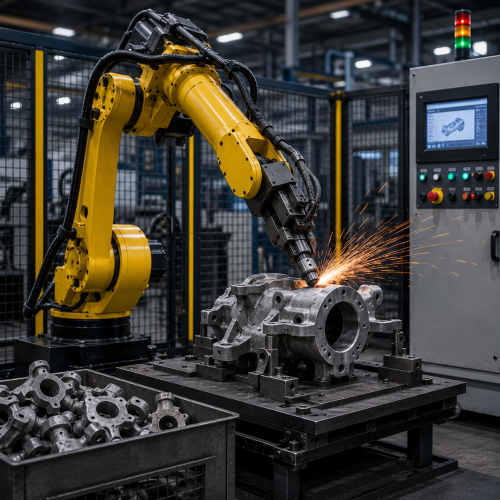
A robotic fettling machine combines an industrial robot arm with grinding, cutting, and deburring tool heads to automate the finishing of cast components. Unlike manual fettling, where output quality depends on operator skill and fatigue, a robotic fettling machine maintains consistent pressure, speed, and tool paths on every part—from the first casting to the thousandth.
For foundries running high-mix, high-volume production, this consistency helps reduce rejected parts, rework costs, and cycle-time variation while improving casting quality and production efficiency. The system can automate gate removal, flash removal, grinding, deburring, and surface finishing with minimal manual intervention.
Programmable robotic motion enables accurate processing of complex casting geometries and repeatable material removal. Integrated tooling and automated part handling further improve process consistency and operator safety. These robotic fettling solutions help modern foundries achieve higher productivity, reliable finishing quality, and optimized manufacturing costs.
Robotic Fettling System Technology
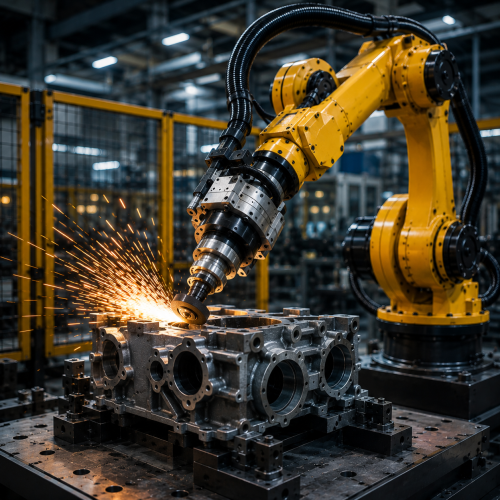
Robotic Fettling System technology represents the next generation of automated casting finishing and surface preparation processes. By combining industrial robots with advanced grinding, deburring, cutting, and finishing tools, the technology enables precise material removal, consistent surface quality, and seamless integration with foundry production lines. This ensures accurate finishing, improved process reliability, and efficient production flow throughout the manufacturing cycle.
The technology is highly adaptable and supports a wide range of fettling applications, including gate and riser removal, flash trimming, grinding, deburring, and surface finishing of ferrous and non-ferrous castings. Its ability to process complex components with speed and precision makes it ideal for industries such as automotive, aerospace, heavy engineering, foundries, railways, and industrial manufacturing. Through intelligent automation, manufacturers can increase productivity, reduce manual labor, improve workplace safety, enhance quality control, and achieve greater operational efficiency in modern casting environments.
Robotic Fettling Equipment — What's Included
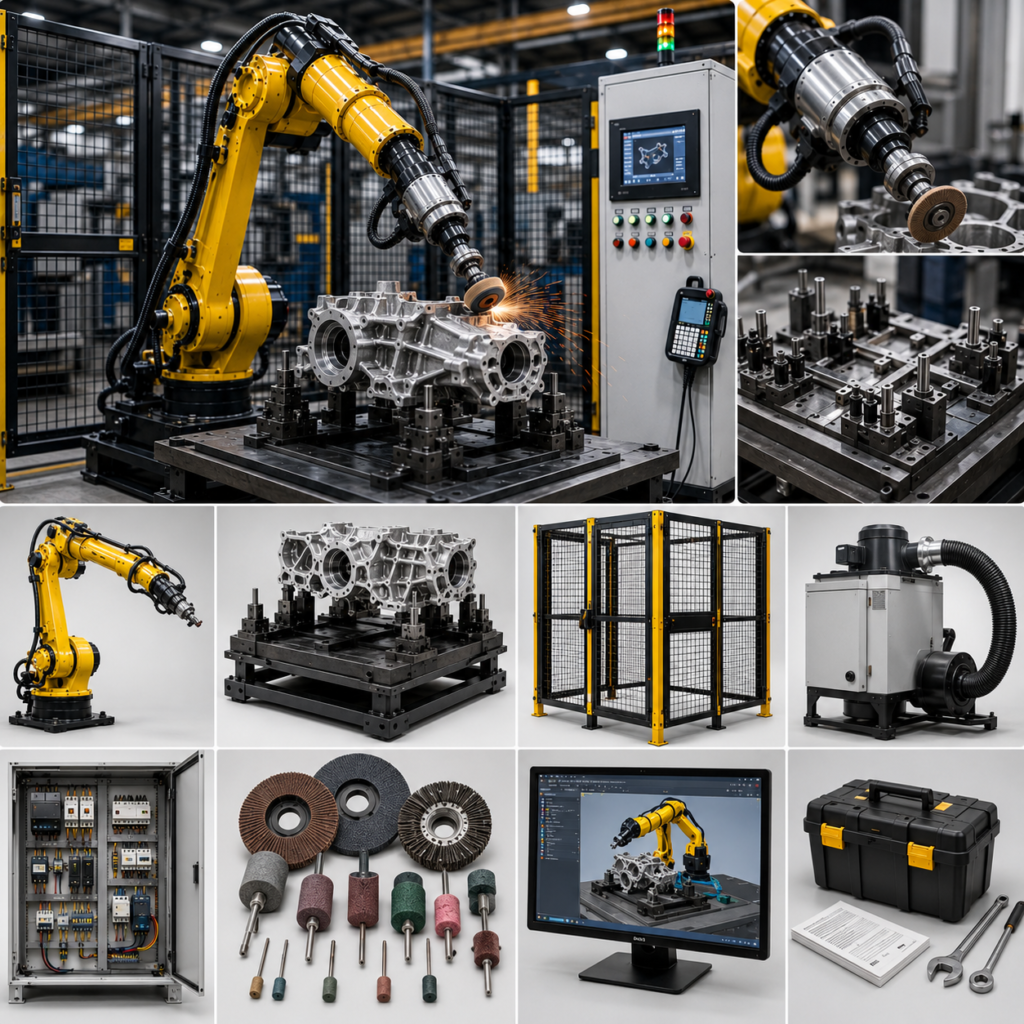
A complete Robotic Fettling Equipment package from Mahajan Automation includes an industrial robot arm selected according to casting weight, dimensions, and reach requirements, along with grinding, cutting, and deburring tools suited for ferrous, aluminium, and non-ferrous castings. The system also incorporates custom part fixtures for secure positioning, force/torque sensing for consistent finishing pressure, dust and spark extraction for workplace safety, and PLC-based controls with recipe storage for quick changeovers between casting types.
The Robotic Fettling System is engineered to automate critical foundry finishing operations such as gate removal, flash removal, fettling, grinding, and deburring. Programmable robotic motion enables consistent material removal and repeatable surface finishing across complex casting geometries. Automated tooling helps reduce operator dependency and improve production cycle times. Integrated safety systems support reliable operation in demanding foundry environments. This customized robotic foundry automation solution helps manufacturers achieve higher productivity, consistent casting quality, and efficient finishing processes.
Robotic Fettling of — Aluminium Castings
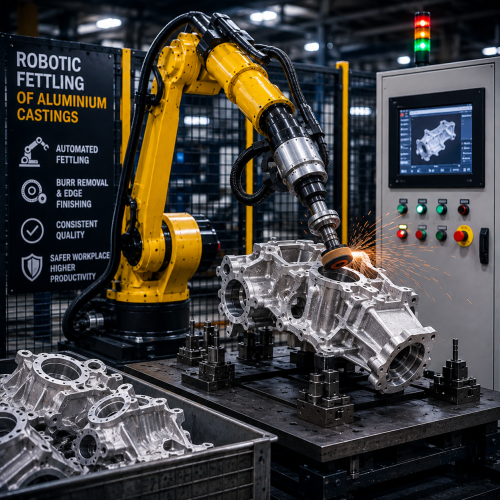
Aluminium castings present unique fettling challenges because the material is softer and more prone to surface damage from excessive grinding pressure. Precise removal of gates, risers, and flash is essential for automotive and heavy engineering components with tight dimensional tolerances.
Mahajan Automation’s Robotic Fettling System uses force-controlled tooling calibrated for softer non-ferrous materials, helping prevent over-grinding while ensuring consistent material removal. Vision-guided positioning allows the robot to handle minor casting variations without manual repositioning.
Typical applications include:
1) Automotive engine and transmission housings
2) Aluminium suspension and structural components
3) Aluminium pump and valve bodies
Robotic Intelligent Automation in Robotic Fettling Systems
Precision Grinding and Deburring
A Robotic Fettling System delivers highly accurate grinding and deburring of cast components with consistent quality. Using advanced robotic automation, force control, and precision tooling, it removes excess material efficiently while minimizing dimensional variations, improving surface finish, and reducing manual rework across high-volume manufacturing operations.
Automated Gate and Riser Removal
Industrial Robotic Fettling Systems automate gate, riser, and flash removal with exceptional precision. Intelligent robotic arms ensure clean, repeatable cuts on complex castings, reducing production time, improving component quality, and increasing throughput while minimizing operator fatigue and material waste in foundry environments.
Improved Workplace Safety
A Robotic Fettling System reduces worker exposure to sparks, dust, vibration, heavy castings, and hazardous finishing operations. By automating repetitive fettling processes, manufacturers create a safer workplace, lower injury risks, improve regulatory compliance, and maintain continuous production with minimal human intervention.
Consistent Surface Finishing
Robotic automation provides uniform surface finishing on every casting regardless of complexity. Equipped with intelligent sensors and programmable controls, Robotic Fettling Systems maintain consistent grinding pressure and finishing quality, ensuring superior product appearance, dimensional accuracy, and reliable performance for demanding industrial applications.
Higher Productivity and Lower Costs
Advanced Robotic Fettling Systems optimize casting finishing by reducing cycle times, minimizing scrap, and lowering labor costs. Automated grinding, trimming, and deburring improve operational efficiency while increasing production capacity, enabling manufacturers to achieve faster delivery schedules and better return on investment.
Flexible Integration with Foundry Automation
A Robotic Fettling System integrates seamlessly with conveyors, machine vision, industrial robots, PLC controls, and automated material handling systems. This flexible solution supports different casting sizes and production requirements, helping manufacturers build smart foundries with improved efficiency, quality control, and scalable automation.
Robotic Fettling System Application's

Automotive Casting Finishing
A Robotic Fettling System automates grinding, deburring, flash removal, and surface finishing of automotive engine blocks, brake components, transmission housings, and suspension parts. Using robotic grinding automation, manufacturers achieve consistent quality, improved dimensional accuracy, faster production cycles, reduced manual labor, and enhanced workplace safety across high-volume automotive manufacturing.

Foundry Casting Operations
In foundries, Robotic Fettling Systems efficiently remove gates, risers, flash, and excess material from iron, steel, and aluminum castings. Integrated industrial automation and robotic finishing ensure repeatable surface quality, minimize rework, reduce production costs, and improve throughput while maintaining consistent results for complex casting components.

Heavy Engineering Components
Heavy engineering manufacturers use robotic fettling automation to process large cast components, machine bases, pump housings, valve bodies, and industrial equipment parts. Automated grinding and deburring provide precise finishing, increase productivity, reduce operator fatigue, and deliver uniform quality even in demanding, high-load manufacturing environments.

Aerospace Component Finishing
A Robotic Fettling System performs precision grinding and deburring of aerospace castings requiring tight tolerances and superior surface finishes. Advanced robotic control, force sensing, and automated material removal improve component reliability, reduce defects, ensure consistent quality, and support strict aerospace manufacturing and inspection standards.

Railway and Transportation Parts
Railway manufacturers use robotic surface finishing systems to process cast wheels, couplings, brake components, and structural parts. Automated fettling removes excess material accurately, improves component durability, enhances surface quality, and supports continuous production with reduced downtime, consistent performance, and improved operator safety.

Valve, Pump, and Industrial Equipment Manufacturing
A Robotic Fettling System automates finishing of cast valves, pump housings, impellers, compressors, and industrial machinery parts. By integrating robotic deburring, grinding, and intelligent automation, manufacturers achieve faster cycle times, consistent surface quality, lower operational costs, reduced scrap, and higher production efficiency.
Looking for downstream surface finishing after fettling? See our Robotic Grinding System for the next step in casting finishing.
Benefits of Robotic Fettling System
Consistent Surface Finishing Quality
A Robotic Fettling System delivers precise grinding, deburring, flash removal, and surface finishing with exceptional repeatability. Advanced robotic automation ensures every casting meets strict quality standards, minimizing defects, reducing rework, and improving product consistency across high-volume manufacturing and foundry production environments.
Improved Workplace Safety
Automating fettling operations keeps workers away from hazardous tasks involving sparks, dust, vibration, heavy castings, and high-speed grinding tools. Robotic automation creates a safer work environment by reducing manual handling, lowering accident risks, and improving compliance with industrial safety standards in foundries and manufacturing plants.
Increased Production Efficiency
A Robotic Fettling System operates continuously with high accuracy, reducing cycle times and increasing throughput. Automated casting finishing eliminates production bottlenecks, improves machine utilization, and enables manufacturers to meet demanding production schedules while maintaining consistent quality and operational efficiency.
Lower Operating Costs
By reducing manual labor, minimizing material waste, and decreasing rework, robotic fettling significantly lowers production costs. Intelligent process control optimizes grinding and deburring operations, extends tool life, and reduces maintenance requirements, helping manufacturers achieve greater profitability and long-term cost savings.
Flexible Handling of Complex Castings
Modern Robotic Fettling Systems can process cast components of different sizes, shapes, and materials with ease. Integrated robotic arms, force control, and machine vision systems automatically adapt to complex geometries, ensuring precise finishing for automotive, aerospace, foundry, and heavy engineering applications.
Frequently Asked Questions FAQ
What is a Robotic Fettling System?
A Robotic Fettling System is an automated solution that uses industrial robots to perform grinding, deburring, flash removal, gate cutting, and surface finishing on cast components. It improves precision, consistency, productivity, and workplace safety while reducing manual labor.
What are the benefits of using a Robotic Fettling System?
A Robotic Fettling System reduces cycle time, cuts manual grinding labor, and delivers consistent finishing quality across every casting batch. Manufacturers typically see lower rework rates, reduced material waste, improved dimensional accuracy, and a safer shop floor compared to manual fettling.
Which industries use Robotic Fettling Systems?
Robotic fettling machines are widely used across automotive casting, foundries, heavy engineering, aerospace components, railways, and valve/pump manufacturing — anywhere ferrous or non-ferrous castings need gate removal, deburring, or surface finishing at scale.
What operations can a Robotic Fettling System perform?
A robotic fettling system handles gate and riser removal, flash trimming, grinding, deburring, and edge finishing on cast components. Robotic fettling equipment can be configured with interchangeable tooling and force control to handle both simple and geometrically complex castings.
Why choose a Robotic Fettling System over manual fettling?
Key advantages include enhanced precision, improved safety, reduced material waste, and long-term cost savings. As a result, businesses gain better ROI and competitive manufacturing capabilities.
What's included in a robotic fettling equipment package?
A typical package includes the robot arm, grinding/cutting/deburring tool heads, part fixturing, force/torque sensing, dust and spark extraction, and PLC-based controls — sized and configured around your casting material and production volume.
Can a robotic fettling machine handle aluminium castings?
Yes. Aluminium requires lower, more controlled grinding pressure than iron or steel to avoid surface damage. Mahajan Automation configures force-controlled tooling specifically for aluminium castings so gates and flash are fully removed without over-grinding the softer material.