
Robotic Grinding System
Upgrade your manufacturing with our Robotic Grinding Machine and System, delivering exceptional precision, surface finishing, and consistent quality. Moreover, automation minimizes manual effort, reduces errors, improves workplace safety, and enhances productivity across grinding operations. Experience smarter, faster, and cost-effective robotic grinding solutions — transform your production process today!
Industrial Robotic Grinding System for Modern Manufacturing
Optimize your manufacturing operations with our Robotic Grinding System, designed to deliver precise surface finishing, consistent quality, and improved productivity across industrial applications. Moreover, robotic automation reduces manual effort, minimizes errors, enhances workplace safety, and ensures faster grinding processes.
Our Robotic Grinding System provides accurate material removal, burr removal, edge finishing, and surface smoothing with excellent process repeatability. It is ideal for high-volume manufacturing where consistent surface finish, grinding accuracy, and production efficiency are essential.
With advanced robotic arms, automated grinding tools, force control, and intelligent motion programming, the system delivers reliable and cost-effective automated grinding solutions for modern industries.
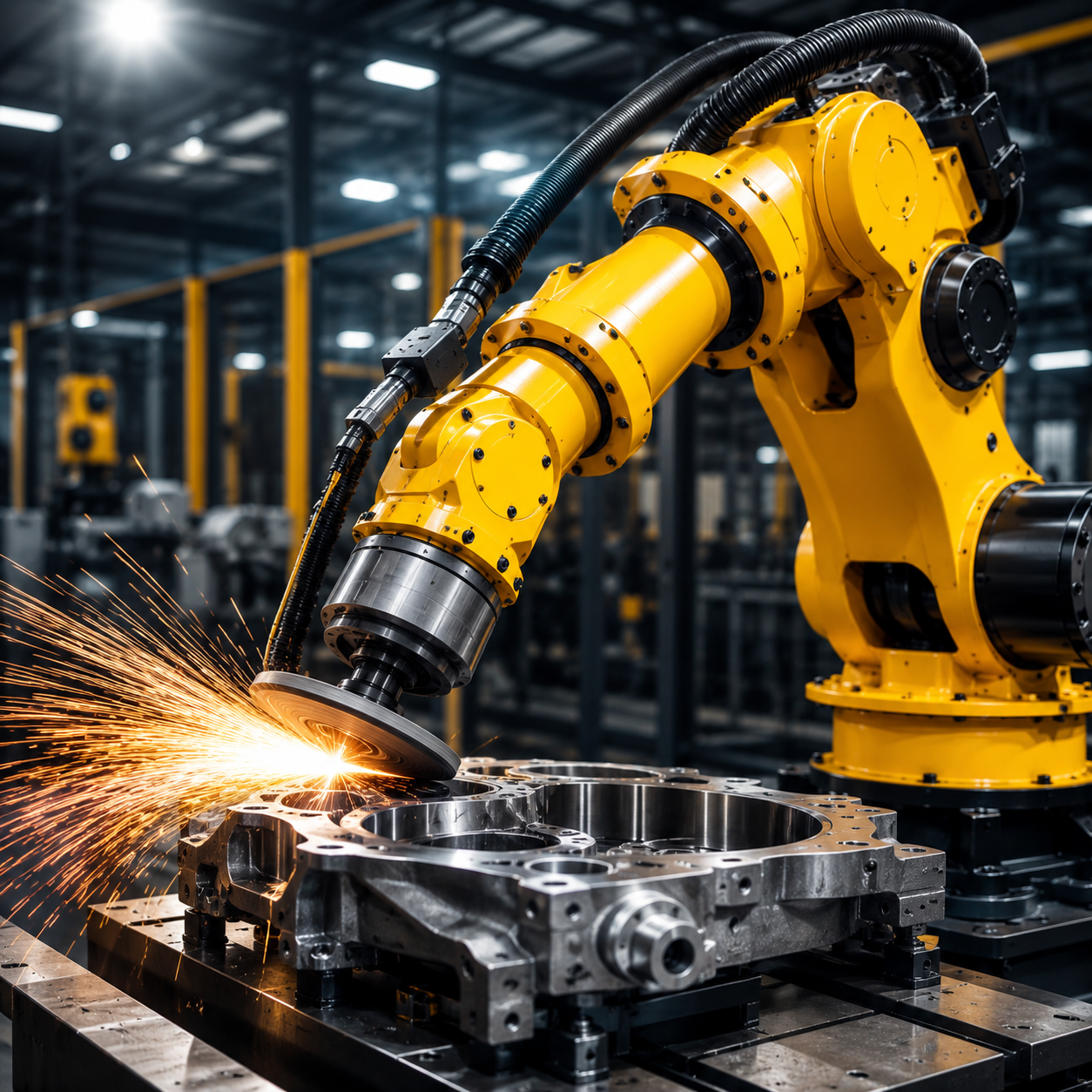
What is a Robotic Grinding Machine?
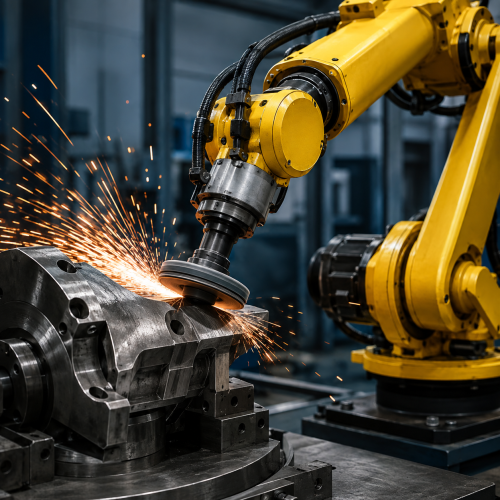
A robotic grinding machine combines an industrial robot arm with grinding wheels, abrasive belts, or discs to automate surface finishing, deburring, edge finishing, and material removal on metal components. Unlike a conventional grinding machine that requires an operator to load, position, and guide each part manually, a robotic grinding machine can automate the complete process—including part handling, programmed grinding paths, contact pressure, and unloading—helping maintain consistent results from the first component to the last.
This level of grinding automation improves surface finish, process repeatability, production efficiency, and operator safety. It makes robotic grinding an ideal solution for manufacturers looking to replace labor-intensive finishing with precise, reliable, and repeatable automated production. The system can handle complex component geometries while maintaining consistent grinding pressure and tool movement. Automated grinding systems also reduce material waste, operator dependency, and process variation. With programmable robotic motion, manufacturers can achieve faster cycle times and stable finishing performance. These capabilities make robotic grinding solutions suitable for high-volume and demanding industrial applications.
Robotic Grinding System Technology
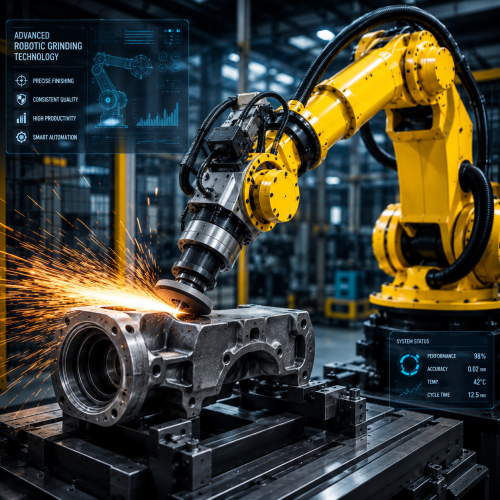
Robotic Grinding System technology represents the next generation of automated surface finishing and material processing solutions. By integrating industrial robots with advanced grinding tools and intelligent control systems, the technology enables precise component handling, automated grinding operations, and consistent surface finishing. This ensures superior accuracy, improved process reliability, and efficient production workflows across various manufacturing environments.
The technology is highly versatile and supports a wide range of grinding applications, including surface grinding, deburring, polishing, edge finishing, and material removal operations. Its ability to handle complex components with speed and precision makes it ideal for industries such as automotive, foundry, aerospace, heavy engineering, and metal fabrication. Through advanced robotic automation, manufacturers can achieve consistent quality, reduce manual effort, improve workplace safety, minimize production errors, and enhance overall productivity in modern industrial operations.
Robotic Grinding Cell —A Complete Turnkey Workstation
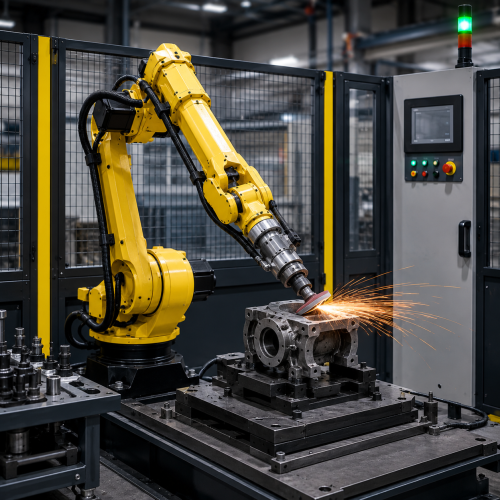
A robotic grinding cell is a fully enclosed workstation that combines the robot, grinding tools, part fixturing, safety guarding, and dust and spark extraction into one integrated system. It is designed for direct installation on the shop floor, providing a complete automated grinding solution without the need to assemble individual equipment separately.
Mahajan Automation designs robotic grinding cells according to your component requirements, production volume, and finishing process, including:
1) Single or multi-station cells for parallel component processing
2) Automatic tool-change systems for multiple grinding and finishing operations
3) Conveyor integration for smooth upstream and downstream material flow
4) Safety enclosures and interlocks for secure industrial operation
A robotic grinding cell is ideal for dedicated finishing applications where manufacturers require consistent surface finish, accurate material removal, improved productivity, and repeatable grinding performance for specific component families.
Robotic Grinding and Polishing —Combined Finishing in One Cycle
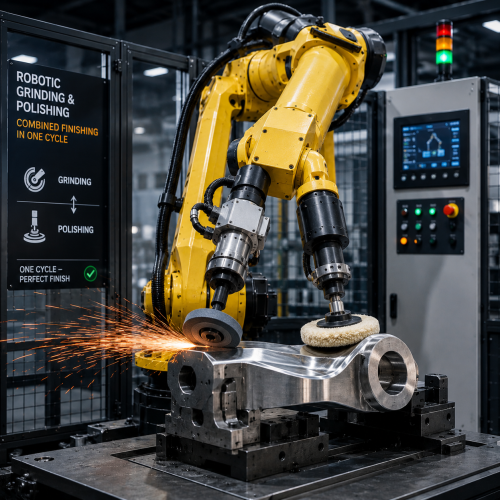
Many components require both grinding to remove excess material and surface defects and polishing to achieve the required smoothness and appearance before final production. Performing these operations separately can increase handling time, labor dependency, and variation between operators.
A robotic grinding and polishing system combines both processes within a single automated workflow. The robot can switch between grinding wheels, abrasive belts, polishing pads, and compounds during the programmed cycle, or transfer components between dedicated stations. This automated grinding and polishing solution delivers consistent material removal, surface finish, and process repeatability.
It is particularly suitable for automotive components, aerospace parts, metal castings, and consumer-facing products where dimensional accuracy, edge finishing, and high-quality visual appearance are essential.
Robotic Intelligent Automation in Robotic Grinding Systems
Advanced Precision Grinding Control
Robotic intelligent automation ensures accurate tool movement and consistent grinding performance. It maintains precise pressure, speed, and positioning for superior surface finishing and reduced production variations.
Smart Process Monitoring and Optimization
Integrated sensors and intelligent control systems continuously monitor grinding operations. This enables real-time adjustments, improved process stability, and optimized performance for different components and materials.
Automated Material Handling and Flexibility
Robotic systems automate loading, unloading, and component positioning during grinding operations. This improves workflow efficiency and allows quick adaptation to different part sizes and production requirements.
Improved Quality and Consistency
Intelligent robotic grinding delivers uniform finishing results with minimal human intervention. It reduces defects, improves dimensional accuracy, and ensures consistent quality across high-volume manufacturing processes.
Enhanced Safety and Reduced Manual Effort
Automation minimizes operator involvement in hazardous grinding environments involving dust, sparks, and repetitive tasks. This improves workplace safety while reducing physical strain on workers.
Increased Productivity and Cost Efficiency
Robotic intelligent automation enables faster cycle times, reduced downtime, and efficient resource utilization. Manufacturers can achieve higher productivity and lower operational costs with reliable grinding solutions.
Robotic Grinding Systems Application's

Automotive Component Grinding
Robotic Grinding Systems are widely used in the automotive industry for precision grinding of engine parts, transmission components, brake components, and metal castings. These automated solutions ensure consistent surface finishing, accurate dimensions, and reduced defects while improving production speed.

Aerospace Component Finishing
Robotic Grinding Systems provide high-precision finishing for aerospace components requiring strict quality standards. These systems perform accurate grinding, polishing, and surface preparation while maintaining repeatability and reliability.

Foundry and Casting Surface Finishing
In foundry operations, Robotic Grinding Systems help remove excess material, burrs, and casting imperfections from metal components. Robotic automation ensures uniform finishing quality, improves worker safety, and handles heavy components efficiently.

Heavy Engineering and Fabrication
Heavy engineering industries use Robotic Grinding Systems for finishing large and complex fabricated parts. Automated grinding robots deliver consistent results on weld seams, metal structures, and industrial components while reducing manual effort.

Tool and Die Manufacturing
Robotic Grinding Systems enhance tool and die manufacturing by providing precise material removal, surface correction, and finishing operations. These systems improve accuracy, reduce production time, and support complex component geometries.

Rail and Infrastructure Component Grinding
Robotic Grinding Systems are used for finishing rail components, structural parts, and large industrial assemblies. Robotic automation ensures smooth surfaces, improved durability, and consistent quality in demanding environments. LSI keywords: infrastructure automation, robotic material removal, industrial grinding applications, automated finishing systems.
Benefits of Robotic Grinding System
Improved Grinding Precision and Quality
Robotic Grinding Systems deliver highly accurate and consistent grinding results by maintaining precise tool movement, pressure, and speed. This ensures uniform surface finishing, reduced defects, and improved component quality across high-volume manufacturing operations.
Increased Production Efficiency
Robotic automation enhances grinding productivity by performing continuous operations with faster cycle times and minimal downtime. Robotic Grinding Systems help manufacturers achieve higher output, optimized workflows, and improved overall manufacturing efficiency.
Enhanced Worker Safety
Robotic Grinding Systems reduce the need for manual involvement in hazardous grinding environments involving dust, sparks, vibration, and repetitive tasks. This improves workplace safety while allowing operators to focus on monitoring and process management.
Consistent Surface Finishing
Automated grinding robots ensure consistent finishing quality across different components and production batches. The system maintains stable grinding parameters, reducing variations and delivering superior surface finish for automotive, aerospace, foundry, and industrial applications.
Reduced Operational Costs
By minimizing material waste, rework, and manual labor requirements, Robotic Grinding Systems help reduce production expenses. Their efficient operation improves resource utilization and provides long-term cost benefits for manufacturing industries.
Need to remove gates, risers, and flash before grinding? See our Robotic Fettling System for upstream casting finishing.
Robotic Grinding Tools We Work With
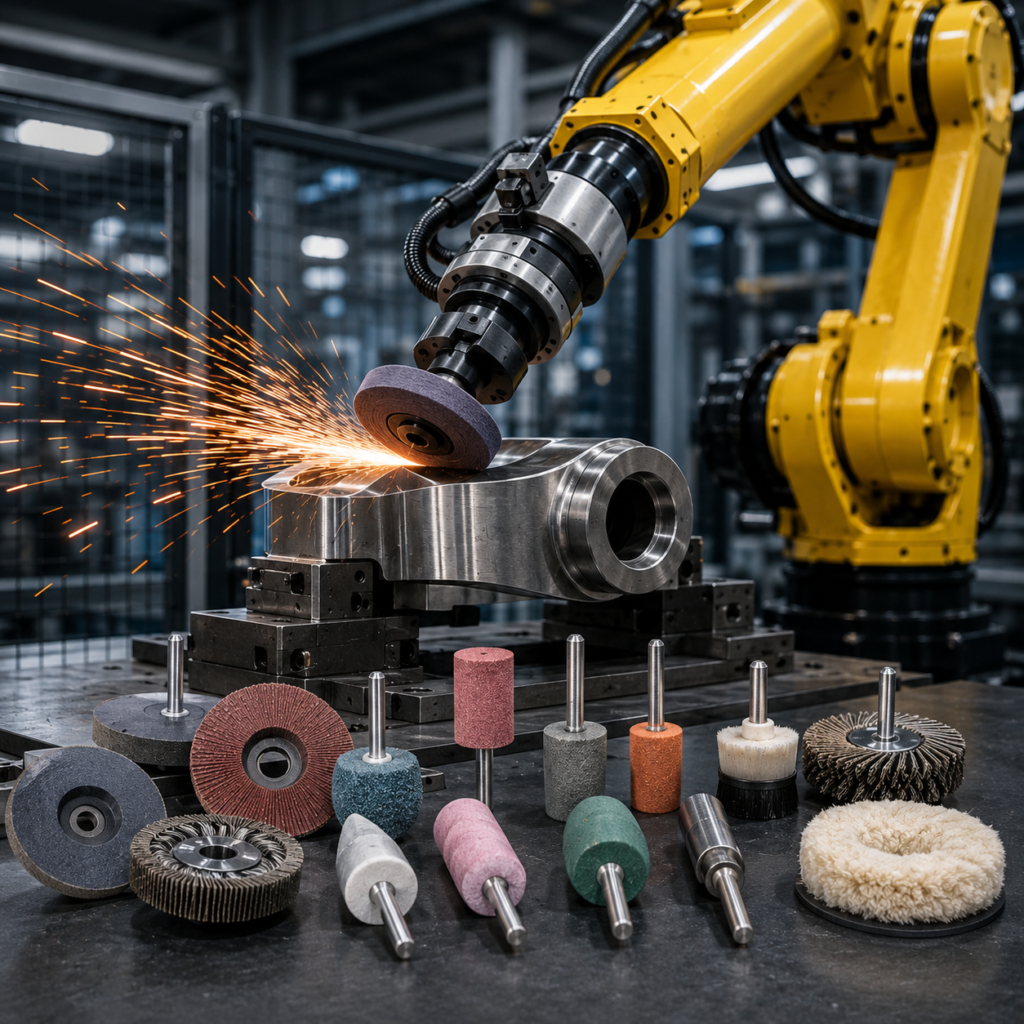
Robotic grinding tool selection—including grinding wheels, abrasive belts, flap discs, wire brushes, and abrasive brushes—depends on the component material, stock removal requirements, surface condition, component geometry, and required finish specification. The right tooling directly impacts material removal rate, grinding accuracy, surface finish, cycle time, and tool life.
Mahajan Automation configures the appropriate grinding tools, robotic end-effector, spindle, and tool-change system according to your application. Our Robotic Grinding System can be equipped for deburring, edge rounding, flash removal, weld grinding, surface smoothing, and precision finishing, delivering consistent results across repetitive production cycles.
The system supports automated grinding and finishing for castings, forged parts, fabricated components, and complex metal components. Application-specific tooling helps maintain consistent contact pressure and grinding performance throughout the production cycle. This enables manufacturers to achieve higher productivity, reduced operator dependency, lower process variation, and reliable surface quality.
Frequently Asked Questions FAQ
What is a Robotic Grinding System?
A Robotic Grinding System is an automated solution that uses industrial robots, grinding tools, fixtures, and process controls to perform grinding, surface finishing, material removal, and deburring with consistent accuracy and repeatability.
What types of grinding applications can robots automate?
Robotic grinding systems can automate casting grinding, weld grinding, surface finishing, deburring, flash removal, fettling, edge rounding, and material removal. They are suitable for components made from cast iron, steel, aluminum, and other industrial materials.
What are the benefits of robotic grinding automation?
Robotic grinding improves productivity, dimensional consistency, surface quality, workplace safety, and process repeatability while reducing manual grinding dependency. It also helps manufacturers maintain consistent grinding parameters across high-volume production.
Can a robotic grinding system handle different component shapes and sizes?
Yes. Robotic grinding cells can be engineered for different component geometries using custom fixtures, interchangeable grinding tools, robot programming, force control, and vision-guided technologies. This makes the system suitable for both repetitive and variable production requirements.
How does a Robotic Grinding System improve workplace safety?
Robotic grinding removes operators from hazardous grinding environments involving dust, sparks, noise, vibration, and repetitive manual operations. Enclosed robotic cells, extraction systems, safety interlocks, and automated material handling can further improve overall shop-floor safety.
What's the difference between a robotic grinding machine and a robotic grinding cell?
A robotic grinding machine refers to the robot and grinding tooling itself. A robotic grinding cell is the complete workstation — the robot, tooling, fixturing, safety guarding, and material handling — packaged as one turnkey unit ready to install on the shop floor.
Can robotic grinding be combined with polishing in one system?
Yes. A single robotic cell can be programmed to perform grinding and polishing in sequence, switching tooling automatically between operations. This is common for components that need both material removal and a cosmetic final finish, such as automotive or consumer-facing parts.