
Modern manufacturing and logistics facilities face relentless pressures: skyrocketing customer demand, strict safety mandates, shorter fulfillment windows, and unpredictable labor availability. To maintain a competitive edge, plant managers must optimize every square foot of their facility floor. However, a major bottleneck continues to slow down operations—internal material transport. The decision between implementing automated material handling robots and relying on traditional manual transfer methods directly impacts a facility’s overall throughput, operational efficiency, and long-term profitability.
Relying strictly on human labor and conventional material transport methods exposes high-volume operations to significant risks. Manual material transfer often results in unpredictable cycle times, product damage, and high workplace injury rates. In contrast, deploying advanced material handling robots streamlines internal logistics by converting slow, error-prone manual steps into smooth, continuous, and automated workflows.
Transitioning from manual transfer to an automated model is more than just buying new machinery; it represents a strategic shift in factory logistics. Industrial facilities can significantly increase daily output while protecting their workforce by integrating modern applications of robots in material handling, such as high-speed pick and place cells, autonomous transport systems, and articulated robotic arms.
Understanding the Shift: Manual Material Handling vs. Robotic Automation
For decades, manual material transfer formed the baseline of industrial supply chains. Factory floors relied entirely on manual labor, hand trucks, forklifts, and overhead hoists to move raw materials, semi-finished goods, and finished inventory between workstations. While manual labor offers short-term operational flexibility, its limits quickly become apparent as manufacturing volumes scale up.
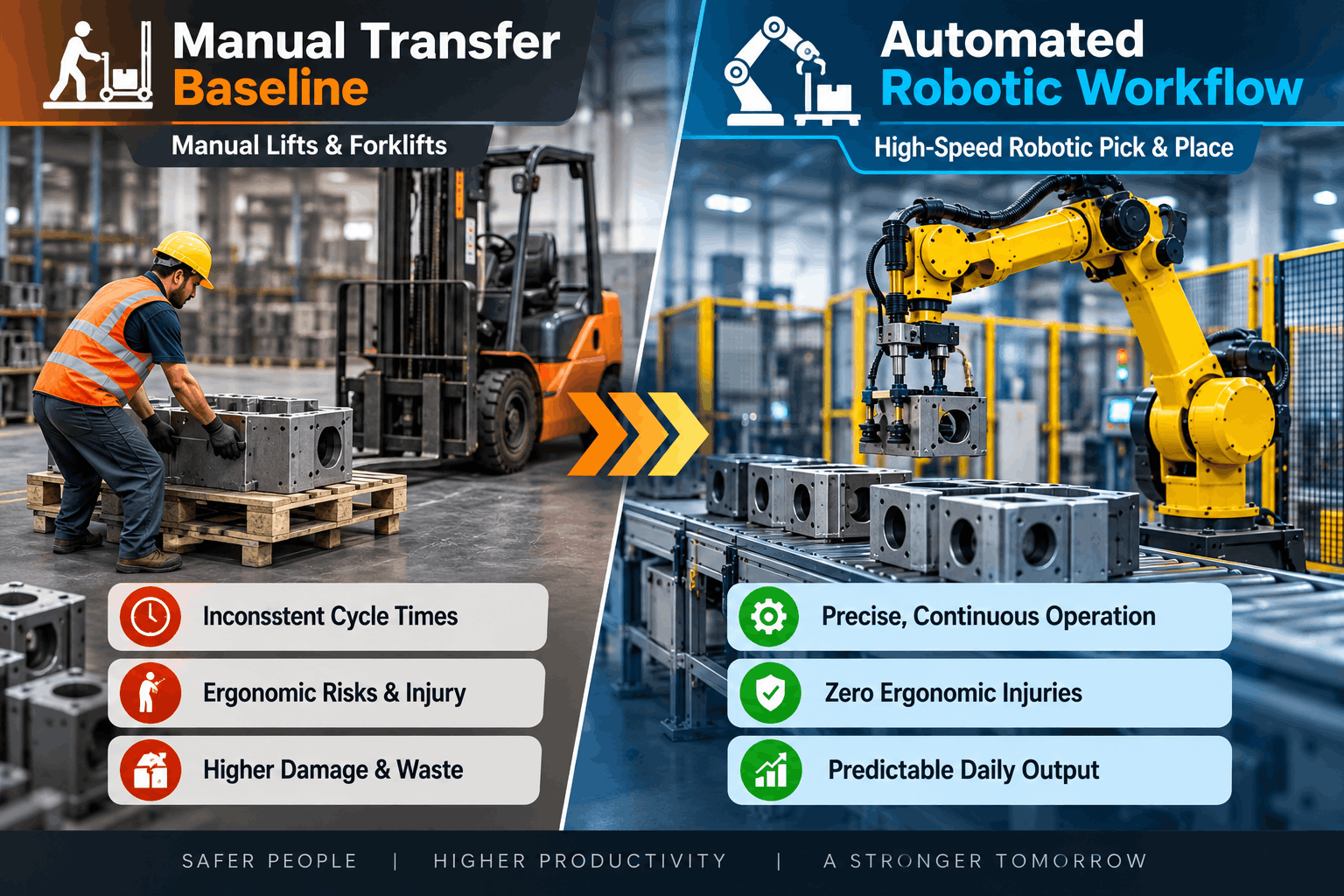
Manual handling inherently limits operational consistency. Human operators experience physical fatigue during long shifts, leading to variations in cycle times, material staging delays, and occasional handling errors. Furthermore, transporting heavy items or handling repetitive lifting tasks introduces major ergonomic hazards, which can cause severe musculoskeletal disorders, costly worker compensation claims, and unwanted downtime.
Implementing automated material handling robots transforms these operational dynamics. Industrial robots operate with extreme precision, delivering uniform execution speed across every shift. Automation eliminates human fatigue, drastically lowers product damage rates, and ensures continuous material flow from initial receiving docks to end-of-line packaging areas.
| Operational Metric | Manual Material Transfer | Automated Material Handling Robots |
| Operational Throughput | Variable; constrained by shift hours and human fatigue | Continuous 24/7 high-speed operation with predictable cycle times |
| Workplace Safety | High risk of ergonomic injuries, slips, and forklift collisions | Built-in safety sensors and enclosed robotic cells minimize human risk |
| Handling Precision | Subject to operator error, misplacement, and product damage | Sub-millimeter accuracy and repeatable handling |
| Labor Cost Structure | High recurring overhead, overtime costs, and turnover risks | Fixed capital investment delivering long-term labor cost reduction |
| Scalability | Demands extensive hiring, training, and shift management | Scalable by adjusting software parameters and payload profiles |
Throughput Optimization: How Automated Material Handling Robots Accelerate Production
In modern industrial facilities, throughput directly dictates profitability. Every delay in material transfer creates a bottleneck, keeping expensive downstream machinery idle. Automated material handling robots resolve these delays by standardizing material movement and synchronizing every stage of manufacturing.
1. Eliminating Bottlenecks with High-Speed Pick and Place
Repetitive sorting, orientation, and staging processes frequently slow down production lines. Integrating a specialized pick and place robotic cell allows parts to move rapidly between conveyors, processing stations, and packaging trays without human pause. Vision-guided robotic systems can easily identify, orient, and transfer randomly positioned items at speeds unattainable by manual labor.
2. High-Capacity Material Loading and Unloading
When manufacturing heavy machinery, automotive components, or packaged consumer goods, manual handling severely restricts transfer speeds. Deploying a heavy-duty material handling robot arm provides the substantial payload capacity required to move dense castings, steel sheets, or bulk cases effortlessly. Robots execute repetitive lifting sequences within seconds, maintaining continuous machine feeding and maximizing overall equipment effectiveness (OEE).
3. Continuous 24/7 Operational Availability
Unlike human operators who require regular rest breaks, shift rotations, and holiday downtime, industrial automation systems run continuously. Implementing material handling robots allows manufacturing facilities to operate three full shifts seamlessly, maximizing machine utilization and significantly increasing daily plant production.
Elevating Plant Safety: Protecting Workers and Reducing Risks
Industrial workplace safety is a critical operational requirement. Material transport ranks among the primary causes of severe industrial injuries, with heavy manual lifting and forklift traffic accounting for most factory floor incidents. Replacing high-risk manual tasks with automated material handling robots significantly improves workplace safety.
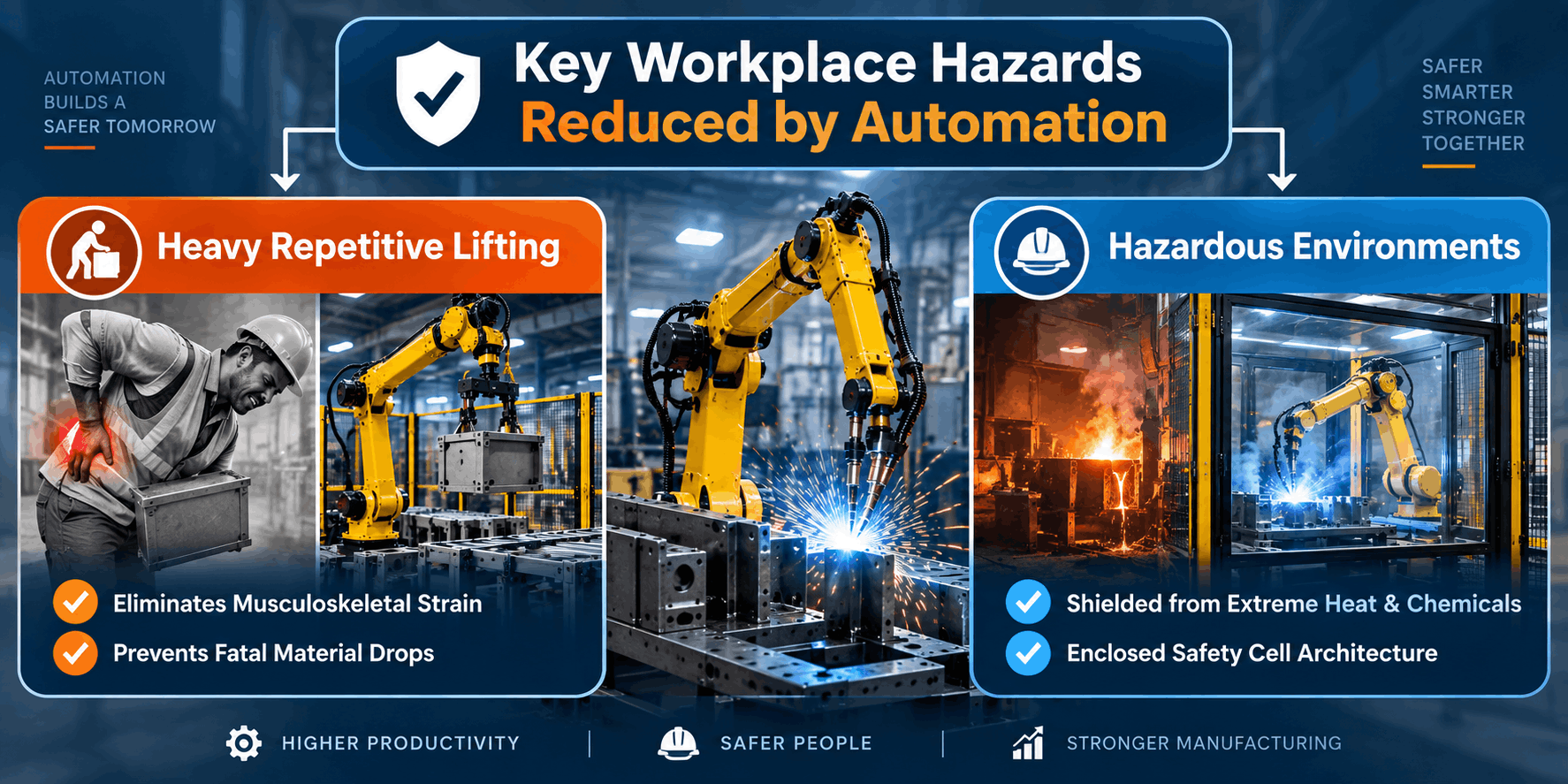
Eliminating Repetitive Strain and Musculoskeletal Injuries
Repetitive manual lifting of heavy boxes, bags, or metal parts places immense physical strain on human workers. Over time, these repetitive motions cause chronic back injuries and joint damage. Automated material handling robots take over these physically demanding tasks, allowing human employees to transition into safer, higher-value roles like system supervision, quality control, and routine maintenance.
Mitigating High-Risk Industrial Hazards
Certain manufacturing processes—such as forge shop press feeding, hot metal handling, chemical processing, and foundry operations—expose workers to extreme heat, hazardous fumes, and high-voltage risks. Specialized robotic systems operate reliably in these hostile environments. Enclosed within robust safety fencing and guarded by light curtains and interlocking safety sensors, automation insulates workers from severe industrial hazards.
Streamlining Factory Traffic & Eliminating Forklift Collisions
Manned forklift operations inside crowded factory aisles represent a major safety risk. Distracted driving, blind spots, and heavy pedestrian foot traffic frequently result in collisions and physical damage. Integrating conveyor networks, robotic gantries, and automated transfer systems creates a controlled, predictable layout, minimizing pedestrian hazards and optimizing internal factory logistics.
For additional guidelines on maintaining occupational health standards and mitigating material handling risks on production floors, plant supervisors can consult official resources provided by the Occupational Safety and Health Administration (OSHA).
Key Applications of Robots in Material Handling Across Industries
Modern industrial robotics solutions offer impressive flexibility, catering to diverse manufacturing needs across diverse sectors. Here are the primary applications of robots in material handling driving real-world industrial productivity:
1. Machine Tending and Part Transfer
Automating machine tending involves using a articulated material handling robot arm to load raw materials into CNC machines, injection molding units, or stamping presses, and extract finished components afterwards. Robotic part transfer eliminates operator downtime, ensures consistent clamp timing, and protects expensive machinery from improper part insertion.
2. Robotic Palletizing and Depalletizing
End-of-line packaging operations demand fast, accurate, and high-capacity stacking. High-speed robotic palletizers effortlessly handle cartons, bags, drums, and crates, building secure, perfectly aligned pallets ready for transit. Robotic depalletizing systems use advanced machine vision to identify and unload mixed-load incoming shipments effortlessly.
3. Vision-Guided Bin Picking
Traditionally, extracting randomly arranged parts from deep bins required manual intervention. Modern material handling robots equipped with 3D machine vision systems scan, locate, and pick randomly oriented components with high precision, feeding downstream production lines continuously without manual intervention.
4. Primary and Secondary Packaging
In food, pharmaceutical, and FMCG packaging lines, strict hygiene standards and rapid cycle times are essential. Automated packaging robots execute precise sorting, pouch handling, tray loading, and carton filling while upholding non-contact hygiene standards.
Calculating the ROI of Automated Material Handling
Upgrading from manual transfer to automated material handling robots requires a clear capital investment evaluation. However, analyzing the full operational impact demonstrates that robotic automation delivers a fast, predictable return on investment (ROI).
Direct Labor Cost Reduction
Direct labor costs involve more than hourly base wages; they include overtime pay, medical insurance, onboarding expenses, shift allowances, and high turnover costs. Implementing automated robotics delivers substantial, permanent labor cost reduction, establishing predictable operational overhead for years.
Drastic Reductions in Scrap and Product Damage
Manual material handling inevitably leads to dropped items, scratched surfaces, and damaged packaging during transit. Material handling robots move items with calculated acceleration, gentle deceleration, and customized end-of-arm tooling (EOAT), virtually eliminating product damage and scrap costs.
Faster Payback Through Capacity Expansion
By unlocking 24/7 continuous production capabilities and accelerating cycle times, automated plants achieve significantly higher revenue per square foot of floor space. Most industrial facilities achieve full financial payback on their automation investment within 12 to 24 months, followed by years of clear cost savings and enhanced margins.
For deeper technical analyses regarding global industrial automation adoption trends and robotic integration standards, engineering teams can explore comprehensive reports published by the International Federation of Robotics (IFR).
Implementing Warehouse Automation with Mahajan Automation
Transitioning from manual transfer to an automated facility requires an experienced system integration partner who understands the complexities of custom factory design. As a premier provider of turnkey robotic engineering solutions, Mahajan Automation helps manufacturing facilities modernize their operational logistics.
With thousands of successful robotic installations worldwide, Mahajan Automation offers end-to-end capabilities tailored to your facility’s exact requirements:
- Turnkey Engineering & Feasibility: Conducting comprehensive material flow analyses, layout optimization, and 3D simulation to guarantee system performance before physical implementation.
- Multi-Brand Robot Integration: Integrating top-tier industrial robot brands—including FANUC, ABB, KUKA, Yaskawa, and Kawasaki—to select the exact payload capacity, reach, and speed for your application.
- Custom End-of-Arm Tooling (EOAT): Designing custom mechanical grippers, vacuum systems, and pneumatic hands to handle delicate, hot, or uniquely shaped parts smoothly.
- Industry 4.0 Integration: Connecting robotic cells directly with existing PLC, SCADA, MES, and WMS networks to enable real-time tracking, predictive maintenance, and operational monitoring.
Whether you need a standalone machine-tending cell or a complete facility-wide warehouse automation system, Mahajan Automation provides complete support—from initial engineering design to installation, operator training, and ongoing technical service.
Strategic Services by Mahajan Automation: Drive Your Automation Journey
Ready to replace slow, high-risk manual material transfer with high-speed robotic precision? Mahajan Automation provides tailored, high-performance automation solutions engineered to elevate your manufacturing capabilities.
Our expert engineering team offers specialized turnkey services across key operational domains:
- Robotic Material Handling Solutions: Custom robotic cells designed for continuous transfer, palletizing, sorting, and bin picking.
- Robotic Forging & Foundry Systems: Heavy-duty robotic automation engineered specifically to thrive in extreme high-temperature and high-risk environments.
- Vision-Guided Robotic Systems: Advanced 2D and 3D camera integrations enabling accurate part identification, quality inspection, and automated bin picking.
- End-of-Line Packaging Automation: High-speed cartoning, tray loading, and case-packing systems tailored for FMCG, food, beverage, and pharmaceutical industries.
Upgrade Your Plant Operations Today
Stop letting manual transfer bottlenecks hold back your daily throughput and compromise worker safety. Contact the engineering specialists at Mahajan Automation today to request an automation feasibility study, schedule an on-site facility audit, or receive a customized quotation for your next project.
Frequently Asked Questions (Q&A)
Q1: What are the primary advantages of automated material handling robots over manual transfer?
Automated material handling robots deliver continuous 24/7 operation, eliminate human fatigue, maintain sub-millimeter precision, and increase overall plant throughput. Furthermore, automation improves workplace safety by removing workers from dangerous, high-risk, and ergonomically taxing tasks, leading to substantial long-term labor cost reductions.
Q2: How do material handling robots improve workplace safety on the factory floor?
Material handling robots execute high-risk tasks such as lifting heavy payloads, transferring hot forged parts, and working near hazardous machinery. Enclosed within protective safety cells fitted with light curtains, interlocks, and presence sensors, robots isolate operators from severe physical hazards and eliminate repetitive strain injuries.
Q3: What factor determines the selection of a robotic arm’s payload capacity?
Payload capacity is determined by evaluating the maximum weight of the part or material being moved, combined with the weight of the custom End-of-Arm Tooling (EOAT) attached to the robot arm. Engineers also account for dynamic forces generated during high-speed acceleration and deceleration cycles to ensure stable handling.
Q4: Can automated material handling robots integrate with existing factory systems?
Yes. Modern material handling robots seamlessly connect with existing factory networks, including Programmable Logic Controllers (PLCs), SCADA systems, Manufacturing Execution Systems (MES), and Warehouse Management Systems (WMS). This connectivity enables real-time tracking, automated inventory updating, and Industry 4.0 data monitoring.
Q5: How quickly can a facility expect a return on investment (ROI) after installing material handling robots?
Most industrial facilities realize a full return on investment within 12 to 24 months. Payback timelines depend on factors such as daily operational hours, labor overhead savings, scrap reduction, and increased overall production capacity.
Q6: What industries benefit most from applications of robots in material handling?
Robotic material handling benefits a wide array of industries, including automotive, metal forging, foundry, FMCG, food and beverage, pharmaceuticals, chemical manufacturing, e-commerce, and logistics warehousing.