
The industrial landscape across Maharashtra is shifting at a rapid rate. Plant managers, operations heads, and facility owners face mounting pressure to deliver precision parts at record speeds. Meanwhile, skilled manual welders are increasingly difficult to recruit and retain. Consequently, small workshops and large Tier-1 automotive suppliers across Chakan, Bhosari, and Talegaon are turning toward advanced automation.
However, selecting the right partner from the many robotic welding machine manufacturers in Pune can be a complex decision. Installing a robotic arm is only part of the process. True success requires a properly engineered ecosystem—including customized fixtures, safety enclosures, synchronized power sources, and dedicated local support.
This comprehensive guide breaks down Pune’s automation landscape. It explores how to evaluate local welding robot suppliers, calculate realistic payback periods, and partner with experienced system integrators to transform shop floor productivity.
The Rise of Industrial Robotics in Pune’s Manufacturing Hub
Pune has earned its reputation as a premier manufacturing hub in India. The region houses massive automotive clusters, heavy machinery fabricators, and specialized export manufacturing units. To remain competitive against global benchmarks, local enterprises are upgrading from manual arc welding to automated processes.
Manual Welding vs. Robotic Automation
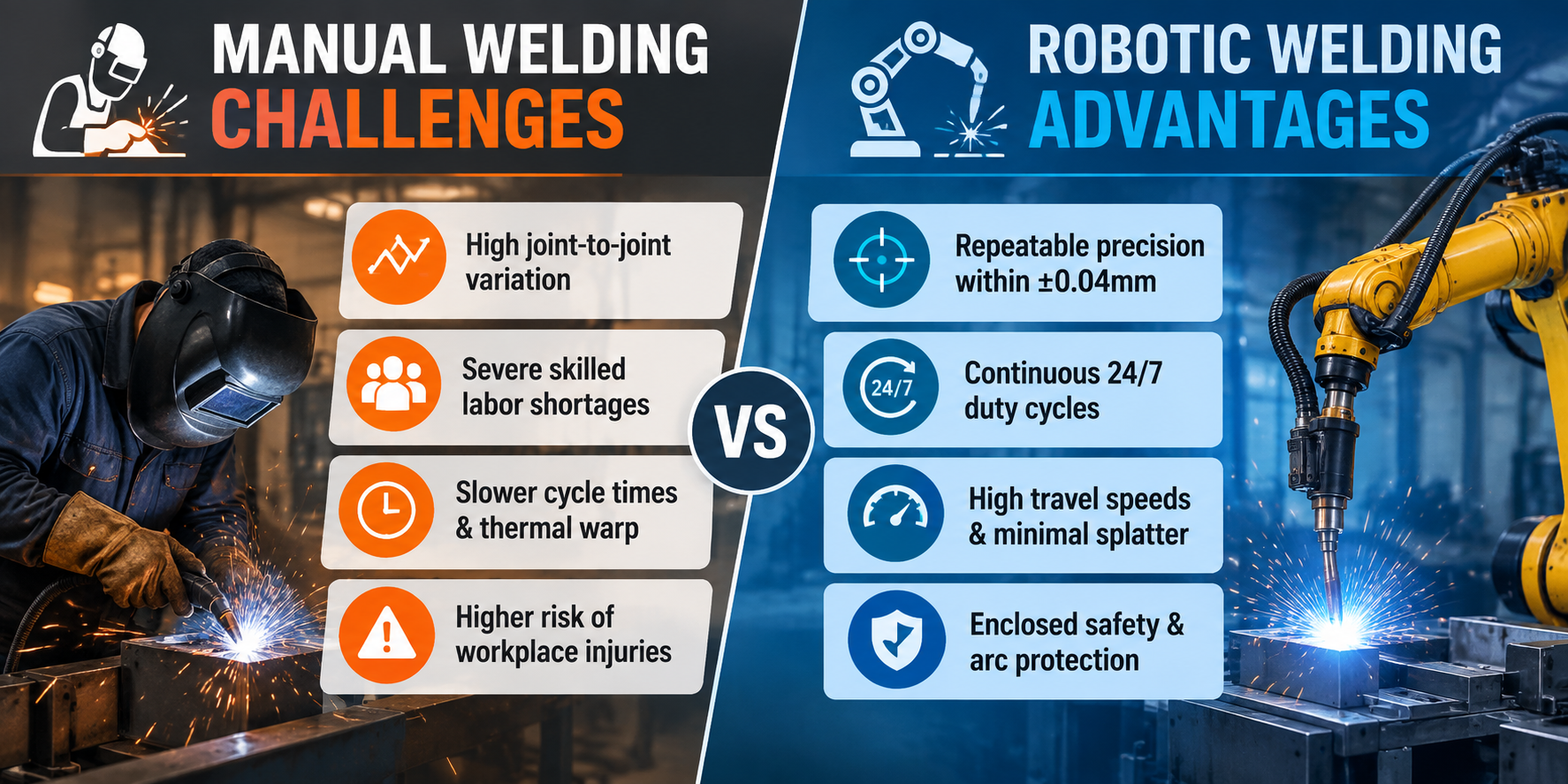
When you transition to robotic welding automation, your shop floor gains several key operational advantages:
- Uncompromising Joint Consistency: Industrial robots execute continuous seams with precise angle control, travel speed, and standoff distance, virtually eliminating weld defects like porosity and undercut.
- Maximized Throughput: Robots operate continuously through multi-shift runs with minimal downtime, significantly speeding up production cycles.
- Lower Overall Material Waste: Precise control over wire feed speed and gas shielding reduces consumable consumption and limits post-weld grinding requirements.
- Improved Shop Floor Safety: Moving operators away from harsh ultraviolet radiation, hazardous fumes, and high spatter zones reduces workplace risks.
Key Criteria for Evaluating Automation Companies in Pune
Deploying robotics requires more than buying off-the-shelf machinery. It demands a tailored engineering solution aligned with your component geometry, production volume, and floor space.
When evaluating potential automation companies in Pune, evaluate candidates against these six core capabilities:
1. In-House Engineering & Application Expertise
A reliable supplier must do more than move hardware. They should analyze your joint configurations, material thickness (from thin sheet metals to heavy structural steel), and thermal distortion characteristics. Choose engineering teams capable of conducting 3D reachability analyses and offline weld simulations before building physical hardware.
2. Custom Fixturing and Tooling Capabilities
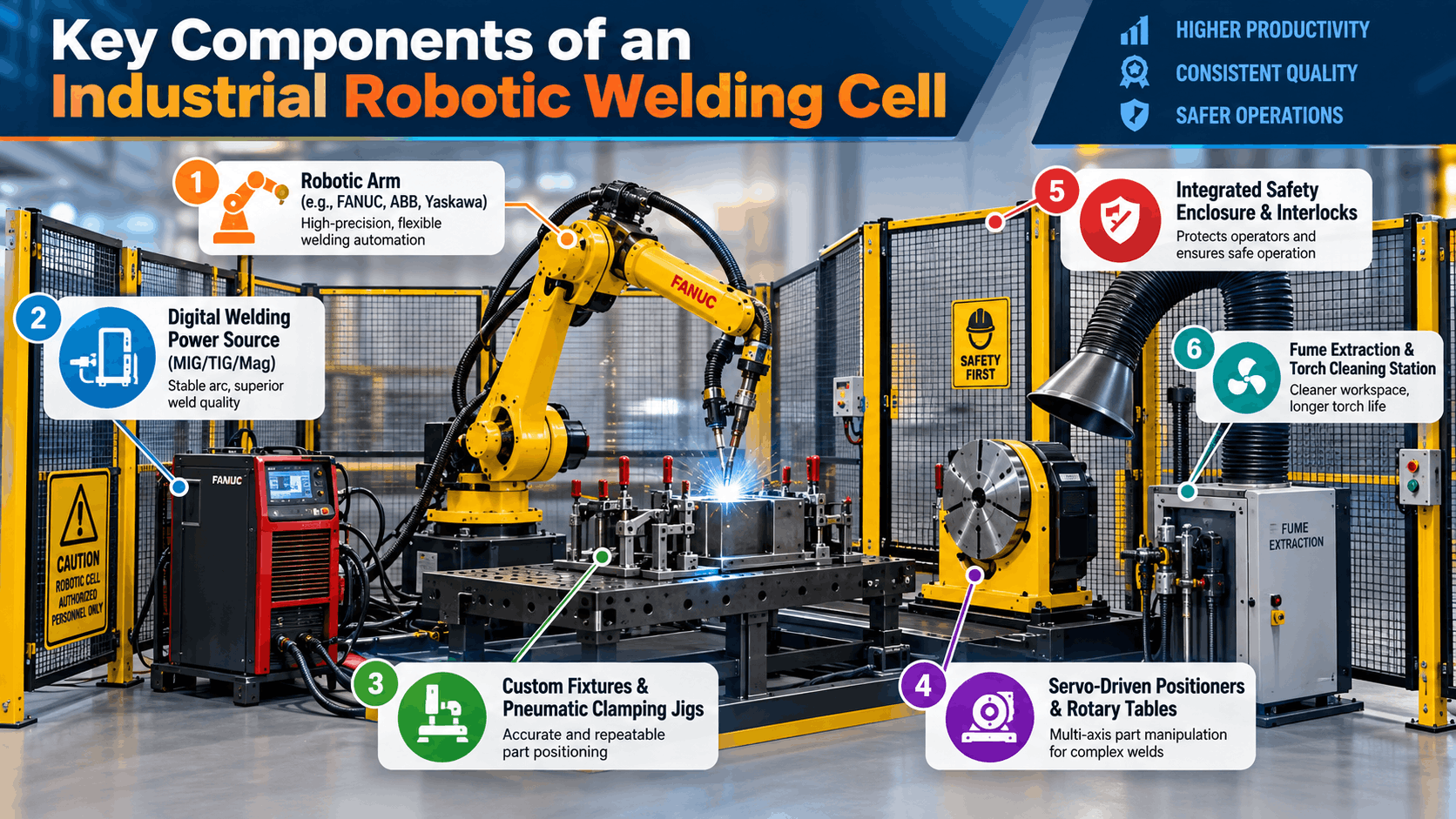
A welding robot is only as accurate as its clamping system. High-performance MIG welding cells depend heavily on customized pneumatic or hydraulic fixtures. Ensure your partner designs robust, repeatable jigs that hold tight tolerances despite thermal expansion.
3. OEM Partnerships with Global Robot Manufacturers
Top-tier system integrators partner with leading global OEMs like FANUC, ABB, Yaskawa, and KUKA. These partnerships ensure access to genuine spare parts, up-to-date controller software, and deep technical documentation.
4. Turnkey Execution Capabilities
Managing multiple vendors for robot arms, power sources, safety light curtains, and PLC controllers often leads to integration delays. Partnering with a supplier that offers full turnkey automation solutions gives you a single point of accountability from initial layout design to final commissioning.
5. Local Field Service and Rapid Spare Parts Support
When a production line stalls in an active hub like Chakan, waiting days for offshore technical support can be costly. Working with local welding robot suppliers in Pune ensures field engineers can reach your facility quickly to restore operation.
6. Training and User Adoption
Advanced hardware is ineffective if your shop floor personnel cannot operate it. Top manufacturers offer comprehensive training programs covering teach pendant operation, basic weld parameter tuning, torch maintenance, and safety protocols.
Comparing Core Welding Technologies
Different manufacturing applications require tailored robotic setups. Leading suppliers evaluate your component specifications to recommend the optimal process:
| Welding Technology | Common Applications | Key Strengths | Considerations |
| Robotic MIG/MAG Welding | Automotive chassis, structural frames, heavy equipment | High deposition rate, fast travel speeds, handles gap variations | Higher spatter if parameters are not tuned |
| Robotic TIG Welding | Stainless steel vessels, aerospace parts, thin-wall tubing | Exceptional aesthetic quality, zero spatter, precise heat input | Slower travel speed, requires tight joint fit-up |
| Robotic Spot Resistance | Automotive body-in-white (BIW), sheet metal assemblies | Fast cycle times, no filler wire required | High power draw, requires heavy payload robots |
| Laser Robotic Welding | Battery packs, precision medical devices, electronics | Minimal heat-affected zone (HAZ), extremely high speed | Requires high capital investment and precise tooling fit-up |
Calculating Your Automation ROI and Payback Period
Investing in industrial robotics is a major capital expenditure that requires clear financial justification. Evaluating return on investment (ROI) involves analyzing several factor beyond the upfront hardware cost:
1. Labor Optimization
A single dual-station robotic cell can often match the output of three to four manual welding stations. This allows facilities to reallocate skilled welders to complex custom jobs while automated cells handle high-volume repetitive tasks.
2. Consumables and Shielding Gas Efficiency
Digitally controlled wire feeders and synchronized gas flow valves reduce filler wire waste and gas consumption by up to 25% compared to manual setups.
3. Elimination of Post-Weld Rework
Post-weld grinding and joint dressing add hidden labor costs. Because robotic cells maintain stable arc characteristics and controlled travel speeds, spatter is minimized and rework drops significantly.
4. Rejection and Scrap Reduction
Repeatable torch positioning dramatically lowers scrap rates on high-value parts, saving money on raw materials and protecting client relationships.
For a deeper dive into evaluating automated welding vs manual methods, explore Mahajan Automation Services to see how custom-tailored cells streamline operational costs.
Step-by-Step Implementation Roadmap
Implementing a robotic system requires careful planning. Leading robotic welding machine manufacturers in Pune follow a structured deployment process to ensure smooth integration:
1.Requirements Analysis & Feasibility Study:Defining technical baselines.
Engineers evaluate component drawings, cycle time targets, material grades, and joint accessibility. A detailed feasibility report establishes clear performance expectations.
2.Simulation & Cell Layout Design:Preventing physical reach bottlenecks.
Using 3D CAD modeling software, integrators simulate the entire robot workspace to check torch clearance, positioner tilt angles, and operator loading zones.
3.Custom Tooling & Fixture Fabrication:Building repeatable holding systems.
Precision fixtures with pneumatic or hydraulic clamps are fabricated to secure workpieces accurately throughout the welding cycle.
4.System Integration & Pre-Commissioning:Testing before delivery.
The robot arm, welding power supply, positioners, safety light curtains, and main control panel are assembled and tested at the manufacturer’s facility.
5.On-Site Installation & Training:Handing over to plant personnel.
The system is installed on your factory floor, connected to main power utilities, and calibrated. On-site training ensures your technicians are comfortable operating the cell safely.
To explore real-world installations and success stories across mid-sized and large manufacturing units, check out our work at Mahajan Automation Projects.
Navigating Safety Standards and Industry Regulations
Safety is paramount when integrating high-speed factory automation systems. Modern robotic cells must protect personnel from mechanical collisions, intense electrical arcs, high heat, and toxic fumes.
Standard industrial safety installations include:
- Physical Interlocked Safety Fencing: Heavy-duty wire mesh perimeters prevent unauthorized access during automatic operation.
- Safety Light Curtains and Pressure Mats: Optoelectronic sensors instantly pause robot movement if an operator enters the loading zone while the arm is active.
- Integrated Fume Extraction Hoods: Source-capture extraction systems remove hazardous weld fumes, helping facilities meet safety compliance standards set by organizations like the Occupational Safety and Health Administration (OSHA).
- Dual-Channel Emergency Stops: Prominently placed E-stop buttons allow personnel to halt operations instantly in an emergency.
Learn more about global robotic safety standards through international bodies like the International Federation of Robotics (IFR), which publishes guidelines on human-robot collaboration and industrial machine safety.
Why Partner with Mahajan Automation?
Choosing an automation supplier means picking a long-term partner for your facility’s growth. Mahajan Automation stands out among robotic welding machine manufacturers in Pune by delivering complete end-to-end automation built for demanding industrial environments.
- Proven Integration Experience: We design and build robust MIG welding cells, TIG automation platforms, and multi-axis positioners tailored to your exact production goals.
- Multi-Brand Flexibility: We work seamlessly with premier robot OEMs like FANUC, ABB, and Yaskawa, helping you choose the best arm for your payload and reach requirements.
- Complete In-House Capabilities: From initial 3D design and custom fixture fabrication to PLC programming and on-site commissioning, we manage the entire project under one roof.
- Dedicated Local Support: Based in Pune, our service team offers fast response times, preventive maintenance plans, and readily available spare parts to keep your lines running.
Ready to Automate Your Welding Operations?
Upgrading your shop floor with custom robotic welding cells improves part quality, boosts throughput, and protects your operational margins against rising labor costs. Whether you are automating a single production line or planning a full plant-wide retrofit, our team is ready to assist.
Contact Mahajan Automation today to request a technical consultation, schedule an on-site facility audit, or receive a tailored quotation for your project.
Frequently Asked Questions (FAQs)
1. What is the average cost of a robotic welding machine in Pune?
System costs vary based on the robot’s payload capacity, reach, choice of welding power source, and fixture complexity. Entry-level single-station cells start at competitive price points, while complex multi-axis systems with custom positioners require larger investments. Contact our engineering team for a customized assessment.
2. How long does it take to deploy a complete robotic welding cell?
A standard turnkey project typically takes 8 to 14 weeks from initial design approval to final commissioning. Timelines depend on fixture design complexity, component lead times, and special customization needs.
3. Can small and medium enterprises (SMEs) afford robotic welding automation?
Yes. Thanks to modular designs and flexible financing options, many SMEs achieve full ROI within 12 to 18 months through increased throughput, reduced scrap, and lower labor costs per part.
4. Which robot brands are best for welding applications?
Brands like FANUC, ABB, Yaskawa, and KUKA excel in robotic welding. The best option for your plant depends on your team’s familiarity, existing equipment, required reach, and specific software feature preferences.
5. How much space is required for a standard welding cell?
A compact, dual-station compact welding cell typically requires a footprint of roughly 3m x 4m. Custom layouts can be adapted to fit tighter shop floor layouts.