
The global manufacturing landscape is shifting at an unprecedented pace, and Indian industries are right at the forefront of this revolution. From automotive assembly lines in Chennai to electronics manufacturing hubs in Pune, automation is no longer a luxury—it is a baseline requirement for survival. However, setting up a fully automated facility with brand-new machinery demands massive capital expenditure. This financial barrier often leaves small and medium enterprises (SMEs) struggling to compete. Fortunately, there is a highly strategic, budget-friendly alternative that is gaining immense traction: investing in high-quality used industrial robots for sale.
Choosing a second hand industrial robot arm allows manufacturing businesses to automate complex processes at a fraction of the cost of new systems. By opting for pre-owned automation machinery, you can drastically compress your return on investment (ROI) timeline while maintaining international standards of precision and throughput. Whether your goal is to optimize robotic welding, streamline heavy-duty material handling, or implement high-speed palletizing, this comprehensive buyer’s guide will navigate you through everything you need to know about purchasing used industrial robots in India.
Why Buy a Second Hand Industrial Robot Arm?
The primary driver behind the surging demand for pre-owned automation in the Indian subcontinent is cost efficiency. When you look at the financials of a modern manufacturing plant, upfront capital allocation dictates your long-term operational flexibility. Selecting a certified pre-owned machine ensures that your business accesses cutting-edge engineering without the premium price tag.
Strategic Financial Advantages
- Capital Conservation: Purchasing brand-new robotic systems involves steep upfront payments, extended import duties, and prolonged shipping timelines. Conversely, choosing used machinery frees up critical liquid capital that your business can deploy toward scaling production or upgrading facility infrastructure.
- Rapid Depreciation Mitigation: Much like a new vehicle, industrial machinery experiences its sharpest drop in asset valuation during its initial two to three years of operation. When you buy a refurbished unit, the previous owner absorbs that initial hit, allowing you to acquire a highly capable asset at a stabilized market value.
- Immediate Factory Availability: Factory lead times for new robotic hardware from international manufacturers can stretch over several months. Pre-owned assets are typically stocked locally, tested, and ready for immediate deployment to your factory floor.
For factories aiming to maintain lean balance sheets while aggressively scaling production volumes, deploying pre-owned assets represents the ultimate avenue for achieving cost-effective automation solutions.
Key Considerations Before Buying Used Industrial Robots in India
Navigating the pre-owned industrial machinery market requires a strict, structured framework. You cannot simply purchase a machine based on its external appearance; you must perform deep due diligence to ensure the equipment aligns perfectly with your production architecture.
1. Defining Application and Technical Requirements
Before browsing available inventory, explicitly map out the exact parameters of your manufacturing application. A robot optimized for high-speed pick-and-place tasks will differ fundamentally from a machine engineered for heavy-duty spot welding.
- Payload Capacity: Calculate the maximum weight the robotic arm must lift, including the weight of the end-of-arm tooling (EOAT) like grippers, welding torches, or vacuum suction pads.
- Reach Limitations: Measure the total workspace radius required to execute the task efficiently without causing structural interference on your factory floor.
- Duty Cycle and Speed: Evaluate the cycle times your production schedule requires to meet daily output targets.
2. Assessing Mechanical and Electrical Health
When assessing a second hand industrial robot arm, request a comprehensive operational history. Reviewing these mechanical facets prevents unexpected operational downtime post-purchase:
- Backlash and Gearbox Wear: Check the axes for excessive play or backlash, particularly in the critical axis 1, axis 2, and axis 3 gearboxes.
- Harness Integrity: Inspect the internal and external cabling networks. Over time, constant twisting and bending can degrade internal wiring, leading to intermittent signal failures.
- Controller Compatibility: Ensure the robot comes paired with its original or a fully compatible control cabinet (such as the KUKA KRC4 or Fanuc R-30iB), complete with teaching pendants and updated software licenses.
Selecting the Right Brand: KUKA, ABB, and Fanuc
The industrial automation market is anchored by several legendary original equipment manufacturers (OEMs). Choosing a globally recognized brand guarantees that you can easily source spare parts, access software patches, and hire skilled programmers within India.
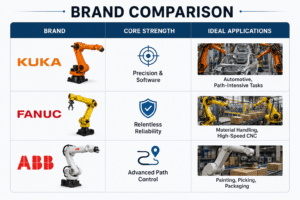
The Market for KUKA Robots
KUKA systems are highly regarded across India for their exceptionally robust German engineering and open-ended software architecture. When calculating the overall KUKA robot price in India, buying a refurbished model offers an incredible value proposition. These machines excel in high-precision paths, making them the gold standard for continuous robotic welding, structural plasma cutting, and intricate assembly operations.
The Versatility of Used ABB Robots
If your production workflows require advanced motion control and unparalleled path accuracy, exploring the market for used ABB robots is highly recommended. Powered by their proprietary TrueMove and QuickMove software algorithms, ABB arms provide smooth, predictable acceleration and deceleration curves. They are highly favored in sectors like food and beverage packaging, consumer electronics assembly, and complex foundry applications.
The Reliability of Used Fanuc Robots
Fanuc is synonymous with maximum uptime and yellow-jacketed reliability. Investing in used Fanuc robots gives your facility access to some of the most popular CNC-integrated systems in the world. Their custom-built control architectures are incredibly intuitive for machine operators, making them ideal candidates for high-speed material handling, machine tending, and heavy-duty palletization matrixes.
The Refurbishment Process: Turning Used Machinery into Reliable Assets
There is a massive, fundamental difference between buying a machine directly from an unverified source and acquiring a professionally refurbished robot. A raw, unvetted machine carries significant operational risks, whereas a certified refurbished asset undergoes rigorous engineering overhauls to mirror its original factory specifications.
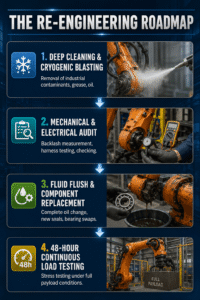
Step 1: Deep Cleaning and Cryogenic Blasting
The refurbishment journey begins by removing years of industrial residue, grease, and overspray. Technicians utilize advanced cleaning methods, including dry-ice blasting, to clean sensitive components without introducing moisture or abrasive degradation to the underlying metal chassis.
Step 2: Mechanical Overhaul and Fluid Replacements
All legacy lubricants, gear oils, and internal greases are completely drained and analyzed for microscopic metallic flakes (which indicate advanced gear wear). The gearboxes are then flushed and refilled with fresh, high-performance synthetic lubricants. Seals, gaskets, and bearings showing even minor signs of wear are immediately replaced with OEM-spec components.
Step 3: Electrical Restructuring and Controller Optimization
Engineers methodically inspect the control cabinet, replace dying CMOS back-up batteries, clean cooling fans, and update the internal software firmware. The teach pendant is thoroughly tested to ensure every single key, touchscreen element, and dead-man safety switch responds flawlessly.
Step 4: Full-Load Stress Testing
A robot cannot be cleared for deployment until it passes rigorous performance validation. Refurbished units undergo continuous, multi-hour stress testing under full payload capacities, executing complex multi-axis motion paths. This step guarantees that repeatability, tracking accuracy, and thermal stability conform strictly to original factory tolerances.
Sourcing Strategies: Used Industrial Robot Auction vs. Certified Automation Integrators
When tracking down used industrial robots for sale, buyers typically face a choice between two main purchasing channels: bidding at an industrial robot auction or partner-buying directly through an established automation integrator.
The Risks of Auctions
Auctions can initially appear highly attractive due to their incredibly low starting bids. However, they operate strictly on an “as-is, where-is” basis. This means you assume all legal and operational risks the moment the gavel falls.
- Zero Testing: You rarely get the chance to power up the machine or check the internal error logs before bidding.
- Missing Components: Auctioned items frequently lack vital connection cables, teach pendants, or software keys, forcing you to source these expensive parts independently.
- Logistical Nightmares: Rigging, heavy lifting, specialized packaging, and transport logistics from the auction site to your facility are entirely your responsibility.
The Security of Certified Integrators
Partnering with an authorized machinery specialist completely eliminates these operational hazards. A dedicated integrator handles the entire procurement cycle, starting from rigorous quality curation and multi-point refurbishment to transport logistics, custom end-of-arm tooling design, and final on-site commissioning. Furthermore, reputable integrators back their inventory with operational warranties and structured technical support contracts, offering complete peace of mind.
To learn more about industrial standards and the global movement toward manufacturing automation, explore the International Federation of Robotics and delve into the technical mechanical validation standards set by the American National Standards Institute.
Integrating Pre-Owned Robots into Your Existing Production Lines
Successful automation deployment extends far beyond anchoring a robotic base into your concrete floor. To unlock the full potential of your second hand industrial robot arm, you must execute a holistic system integration process.
Step-by-Step Integration Matrix
1. Foundation Construction and Mechanical Mounting
Industrial robots exert immense dynamic forces during high-speed directional changes. Your installation site must feature a perfectly leveled, reinforced concrete foundation designed to absorb these torsional vibrations. Secure the robot base using heavy-duty, high-tensile anchor bolts torqued precisely to the manufacturer’s specified ratings.
2. End-of-Arm Tooling (EOAT) Engineering
The robot arm is essentially a highly precise positioning mechanism; its functional capability depends entirely on its tooling. Depending on your target application, you must integrate custom-engineered tooling:
- Welding Applications: Mount a certified MIG/TIG welding torch equipped with an automatic nozzle cleaning station and anti-collision sensors.
- Material Handling: Design customized pneumatic grippers, magnetic lifting arrays, or mechanical claws tailored to your specific product profiles.
3. Safety Enclosure and Sensor Integration
Operational safety is paramount in modern manufacturing. Surround the entire operating envelope of the robot with physical industrial fencing equipped with interlocked access doors. Integrate advanced optoelectronic safety devices, such as industrial light curtains and safety laser scanners, configured to instantly trigger a category-0 emergency stop if a worker breaches the active zone.
Maximizing ROI with Cost-Effective Automation Solutions
To squeeze the absolute maximum financial return out of your refurbished machinery investments, implement a strict preventative maintenance program. While pre-owned robots are highly resilient, their long-term reliability depends heavily on consistent operational care.
Best Practices for Long-Term Reliability
- Daily Inspections: Check for unexpected fluid leaks around the wrist joints and base axes, monitor air pressure gauges, and listen for abnormal acoustic signatures during operation.
- Scheduled Lubrication Audits: Adhere strictly to a structured lubrication schedule. Regularly replace gear grease and oil according to the operational hour milestones defined by the OEM.
- Back-Up Management: Regularly export complete system backups and image files of the robot’s operating system to external, secure cloud drives. In the event of a localized hardware failure or power surge, this practice ensures you can restore production configurations in minutes.
By blending the lowered initial capital expenditure of pre-owned hardware with elite-tier maintenance protocols, your factory can achieve a highly competitive manufacturing edge. This allows you to scale up production capacities while keeping your operational overhead remarkably lean.
Transform Your Production Line with Mahajan Automation
Navigating the pre-owned industrial machinery market requires a trusted partner with deep technical expertise. At Mahajan Automation, we specialize in transforming raw, pre-owned industrial machinery into world-class, production-ready automation assets. We maintain an extensive inventory of elite used industrial robots for sale, including meticulously inspected systems from global industry giants like KUKA, Fanuc, and ABB.
Our team of dedicated automation engineers takes care of every single step of your automation journey—from precision technical sourcing and comprehensive component refurbishment to custom end-of-arm tooling design and turnkey factory floor commissioning. Do not let steep new machinery price tags bottleneck your company’s growth. Partner with Mahajan Automation today to implement highly dependable, cost-effective automation solutions tailored to your precise manufacturing requirements.
Ready to optimize your production line with affordable, high-performance robotic systems? Discover our full range of solutions by visiting Mahajan Automation. Explore our specialized services, or take the next step and contact our engineering team directly via our Mahajan Automation Contact Page to discuss your project requirements and receive a customized quotation today!
Frequently Asked Questions
Q1: Are used industrial robots as reliable as brand-new models?
Yes, provided they go through a comprehensive, professional refurbishment process. When high-quality used industrial robots for sale are stripped down, thoroughly cleaned, fitted with fresh seals, refilled with premium synthetic lubricants, and backed by comprehensive load testing, they deliver exceptional operational reliability and repeatability that closely mirrors brand-new machinery.
Q2: How can I determine the right payload and reach for my factory application?
To correctly calculate your payload requirements, you must add up the total weight of your heaviest part plus the exact weight of your end-of-arm tooling (EOAT), such as grippers or torches. For the reach, map out your factory floor layout to ensure the robotic arm can comfortably access all picking, processing, and placement locations without exceeding its safe mechanical boundaries.
Q3: Is it easy to find spare parts for pre-owned KUKA, Fanuc, or ABB robots in India?
Absolutely. Opting for major global brands like KUKA, Fanuc, and ABB ensures that you can effortlessly source spare parts, specialized component components, and accessories across India. Furthermore, because these systems are widely adopted globally, finding experienced programmers and maintenance engineers is highly straightforward.
Q4: What is the typical lifespan of a refurbished second hand industrial robot arm?
When supported by a strict preventative maintenance regimen, a professionally refurbished industrial robot can easily deliver an additional 8 to 12 years of high-performance service. Their overall longevity is heavily extended by performing routine oil changes, maintaining clean operating environments, and replacing worn seals promptly.
Q5: Can a used robot be reprogrammed for different manufacturing tasks in the future?
Yes, one of the greatest benefits of industrial robots is their inherent flexibility. A robot deployed today for material handling can be completely reprogrammed, retrofitted with a different end-of-arm tool, and redeployed tomorrow for path-intensive tasks like robotic welding or custom cutting.