Robotic welding keeps high-volume manufacturing lines moving at steady speeds with tight bead repeatability. Yet heat, spatter, cable flex, and continuous multi-shift cycles slowly wear down every cell on the shop floor. When a single weld cell stops mid-shift, downstream stamping, machining, or assembly stations quickly stall. Maintenance heads, reliability engineers, and technical leads cannot treat cell upkeep as a low-priority chore. Strong maintenance routines and disciplined weld quality control protect uptime, cut scrap rates, and keep every robotic welding machine accurate across thousands of parts.
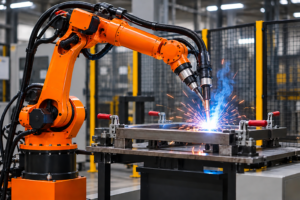
Proactive vs. Reactive Maintenance in Robotic Welding Cells
Running a robotic welding cell in reactive mode means waiting for an alarm, arc fault, or broken part before sending a technician to the line. Reactive work feels fast in the moment, but it creates severe disruption on busy production floors. A sudden failure during peak batch runs forces emergency overtime, delays customer deliveries, and risks rushed repairs that fail again days later.
Proactive maintenance flips that pattern. Instead of reacting to breakdowns, reliability teams schedule inspections and part replacements around arc hours, cycle counts, and early warning signs. Planned work happens during scheduled shifts or changeover windows, giving technicians time to lock out energy, test motion paths, and verify weld quality before full speed resumes.
- Unplanned line stops: Reactive repairs often hit right in the middle of urgent customer orders, creating costly bottlenecks across connected lines.
- Secondary damage: A worn liner or loose fixture can trigger burnbacks or torch collisions that bend tooling and damage nearby sensors.
- Spare parts scramble: Emergency orders cost more, take longer to arrive, and often force teams to install whatever part is on hand rather than the ideal grade.
- Inconsistent weld beads: Gradual drift in torch position or wire feed creates subtle defects that slip past casual checks until entire batches need rework.
Combining scheduled preventive tasks with condition monitoring gives technical leads clear visibility into cell health. Simple habits—such as logging weekly wire pull resistance, tracking contact tip swaps per shift, and recording joint temperatures—turn guesswork into predictable maintenance planning. For teams building or upgrading automated cells, exploring turnkey welding automation solutions helps align cell design with long-term serviceability right from day one.
| Maintenance Approach | Typical Trigger | Impact on Line Uptime | Weld Quality Consistency | Cost & Resource Profile |
| Reactive Maintenance | Breakdown, fault alarm, or scrap spike | Frequent unplanned stops during production | Uneven; defects often appear before stoppage | High emergency labor, rush shipping, high scrap risk |
| Preventive Maintenance | Fixed arc hours, shift counts, or calendar intervals | High; work occurs during planned windows | Steady when intervals match duty cycle | Predictable spare parts and planned technician hours |
| Predictive & Condition-Based | Sensor trends, wire feed force, thermal or vibration checks | Very high; catches wear before failure occurs | Tight control across long high-volume runs | Higher upfront setup; lowest long-term waste |
Identifying Wear and Tear in Critical Robot Parts
Every robotic welding machine relies on a chain of mechanical, electrical, and consumable components working together under harsh conditions. Ignoring wear in individual robot parts leads to arc wander, porosity, incomplete fusion, or nuisance controller faults. Reliability engineers benefit from breaking inspections down by component group so nothing gets overlooked during routine rounds.
Contact Tips, Nozzles, and Wire Feed Liners
Consumables at the front of the torch face direct heat, metal spatter, and constant wire friction. An oval bore inside a worn contact tip causes erratic electrical transfer, leading to unstable arcs, rough weld beads, and wire stubbing inside the tip. Spatter buildup inside the gas nozzle restricts shielding gas flow and deflects gas away from the molten pool.
Inside the cable assembly, wire feed liners wear grooves from thousands of meters of welding wire. Grooved or kinked liners increase wire feed resistance, which can cause birdnesting at the drive rolls or uneven deposition rates. Checking tip bore wear, cleaning nozzles with reamers or anti-spatter care, and running routine wire pull checks keep arc starts clean and steady.
Torch Cables, Dress Packs, and Hoses
Dress packs carry welding power, shielding gas, cooling water, and sensor signals along moving robot axes. Every wrist rotation and arm sweep flexes these lines thousands of times per shift. Tight bend radii, pinched routing brackets, or rubbing against sharp fixture edges slowly fatigue copper strands, crack insulation jackets, and wear pinhole leaks into gas or coolant hoses.
During scheduled audits, technicians should inspect dress packs along their full travel path—especially around axes 3, 4, 5, and 6. Look for flattened cable sections, stiff spots where internal strands have broken, moisture stains near fittings, or chafing against robot castings. Proper slack and strain relief prevent sudden cable snaps that shut down the entire cell.
Servo Motors, Reducers, and Cabling
Robot axes rely on servo motors and precision gear reducers to place the torch within fractions of a millimeter. Over time, heavy payloads, hard stops, or high duty cycles can increase mechanical backlash, warm up motor housings, or degrade encoder feedback signals. Unusual whining, grinding, or clicking during slow jogging often points to bearing wear or lubrication issues that deserve prompt attention.
Keep servo power and feedback connectors clean, dry, and firmly seated. Avoid blowing weld dust or conductive debris directly into motor cooling fins or junction boxes. Following manufacturer grease intervals and checking axis zero-position marks helps preserve smooth motion and repeatable path geometry.
Controller Units, Teach Pendants, and I/O Hardware
The robot controller and power source coordinate motion, arc ignition, safety circuits, and fixture communication. Dust buildup on cooling fans and filters traps heat inside the cabinet, shortening the life of power supplies, circuit boards, and drives. Loose terminal blocks or vibrating relays can also trigger intermittent fault codes that puzzle operators.
Inspect cabinet filters on a regular schedule, verify fan airflow, and check door seals so shop-floor grime stays outside. Test emergency stops, safety gates, and light curtains according to established safety standards such as AWS D16.1M robotic welding safety guidelines and internal lockout/tagout rules before any technician enters the cell.
Calibration, Torch Cleaning Stations, and Seam Tracking Upkeep
Even healthy robot parts lose accuracy over time if reference frames drift or supporting stations fall out of tune. Consistent robotic welding depends on keeping geometry, consumable care stations, and sensing tools tightly synchronized.
Tool Center Point and Fixture Calibration
A small shift in the Tool Center Point (TCP) moves the wire tip away from the programmed weld seam. Minor torch bumps, swanneck deflection, or fixture wear after clamping thousands of parts can push weld placement off target. When TCP accuracy slips, fillet legs become uneven or lap joints miss the intended edge.
Verify TCP regularly using a dedicated calibration pointer, laser check, or touch-sensing routine—especially after changing a swanneck, replacing a contact tip holder, or experiencing a minor collision. Also check part clamping repeatability on jigs and positioners. Worn locating pins, buildup on datum pads, or loose clamps shift parts before the arc even strikes.
Torch Cleaning Stations and Reamer Care
Automated torch cleaning stations—combining a reamer cutter, spatter removal, and anti-spatter spraying—save valuable cycle time on high-volume lines. However, a neglected cleaning station quickly becomes a source of trouble. Dull reamer blades smear spatter rather than cutting it clean, while empty anti-spatter tanks or clogged nozzles leave the front end exposed.
Inspect reamer blades for chips and wear, clear accumulated spatter chips from the housing, and confirm air pressure and anti-spatter spray patterns. Always cut power and follow lockout procedures before servicing moving reamer mechanisms so unexpected cycle starts never catch hands off guard.
Seam Tracking Software and Sensor Maintenance
Part-to-part variation from stamping, laser cutting, or forming is normal in real manufacturing. Seam tracking systems—whether using through-the-arc sensing or optical laser vision—help the robotic welding machine adjust paths in real time so welds stay centered on the joint.
Keep laser lenses, optical windows, and protective covers clean and free of smoke film or spatter mist. Check sensor calibration offsets after torch or bracket adjustments, and confirm that software thresholds match current sheet thickness and joint fit-up. Clean optics and verified parameters keep tracking responsive without false path corrections.
Maximizing Equipment Lifespan and Consistent Weld Quality
Long equipment life and steady weld quality go hand in hand. When maintenance is rushed or skipped, small variations stack up across a shift: shielding gas coverage drops slightly, wire feed stutters, or part fit-up shifts by a millimeter. Across thousands of parts, those small shifts turn into porosity, undercut, lack of fusion, or dimensional distortion.
Reliability teams can lock in strong batch-to-batch quality by pairing disciplined cell care with clear inspection checkpoints. Aligning weld inspection criteria with recognized standards such as ISO 9606 welding qualification and quality standards gives production and quality engineers a shared benchmark for acceptable weld integrity.
- Standardize shift-start checks: Have operators verify gas flow at the nozzle, inspect tip and nozzle condition, clear fixture debris, and confirm part seating before starting production.
- Track wear by arc hours: Base consumable and liner changeouts on actual arc time or weld count rather than guesswork alone.
- Control wire and gas supply: Store filler wire in dry conditions away from floor moisture, and check fittings for leaks so shielding gas stays pure at the arc.
- Audit weld quality routinely: Combine visual checks with macro etching, bend testing, or non-destructive checks on sample parts from high-volume batches to catch subtle process drift early.
- Document every adjustment: Log TCP updates, part replacements, and fault trends so engineers can spot recurring issues before they cause major downtime.
Broadening reliability habits across related automated stations—such as cells covered under broader industrial automation systems—helps keep entire lines balanced rather than leaving one cell ahead of the rest.
How Mahajan Automation Supports Reliable Shop-Floor Operations
Keeping complex automation running smoothly takes practical engineering experience on real factory floors. Mahajan Automation works with manufacturers to design, integrate, maintain, and optimize automated production cells built for demanding industrial duty cycles. Whether your team needs help troubleshooting cell reliability, upgrading legacy stations, or planning new automated lines, you can explore full capabilities on the Mahajan Automation homepage or review specialized industrial robotics solutions tailored to your production goals.
Schedule a Maintenance & Quality Audit for Your Welding Cells
Want fewer unplanned stops, steadier bead quality, and clearer visibility across your automated lines? Connect with the engineering team at Mahajan Automation today to review your current robotic welding cells, identify wear hotspots, and build a practical maintenance and quality control plan for your plant.
Frequently Asked Questions About Robotic Welding Maintenance & Quality Control
1. How often should we inspect a robotic welding machine on a high-volume line?
High-volume cells benefit from quick visual and consumable checks at the start of every shift, plus deeper mechanical, cable, and calibration checks on a weekly and monthly schedule. Adjust exact intervals based on arc hours per day, ambient dust and heat, and part tolerances.
2. Which robot parts cause the most frequent unplanned stops?
Front-end torch consumables, wire liners, and dress pack cables are common culprits because they face constant heat, motion, and spatter. Ignoring minor TCP drift or fixture wear can also cause torch strikes that halt production unexpectedly.
3. How does poor maintenance affect weld quality across large batches?
Worn contact tips, dirty nozzles, or inconsistent wire feeding can cause arc instability, porosity, or uneven fusion. Over a large batch, these issues increase scrap, rework, and inspection delays even if the robot arm itself moves smoothly.
4. Why is TCP verification important after minor torch bumps?
Even a light graze against a fixture or workpiece can bend a swanneck or shift the tool offset slightly. Verifying the Tool Center Point ensures the wire tip stays aligned with the programmed weld joint and seam tracking reference.
5. What should maintenance leads track to improve cell uptime over time?
Track unplanned downtime hours, top fault codes, consumable change intervals, TCP adjustment frequency, and batch defect rates. Reviewing these metrics regularly helps reliability engineers spot worn robot parts early and refine preventive schedules.