
The landscape of global production is shifting at a rapid pace, and India is charging ahead at the forefront of this revolution. Driven by ambitious national initiatives like “Make in India” and a massive push for cross-industry digitalization, the local industrial landscape is shedding its traditional, labor-intensive image. At the heart of this massive paradigm shift lies a singular, defining technological evolution: the widespread integration of advanced smart factory technologies. Today, robotic automation in manufacturing is no longer a luxury reserved exclusively for multinational conglomerates. Instead, it has transformed into an absolute operational necessity for small, medium, and large-scale Indian enterprises striving to compete on a global stage.
For decades, Indian factory floors relied heavily on manual processes, which frequently introduced bottlenecks, human errors, and unpredictable production timelines. However, the modern marketplace demands unprecedented speed, flawless precision, and absolute cost-efficiency. To meet these rigorous demands, forward-thinking business owners are turning to custom industrial robotics. As we analyze the modern industrial sector, it becomes crystal clear that the integration of automated systems is drastically redefining production efficiency, workforce safety, and bottom-line profitability across the Indian subcontinent.
The Rise of Robotic Automation in Manufacturing within India
Historically, the adoption of robotic arms and complex automated systems within India was slow. Heavy initial capital expenditure and a steep technical learning curve held back the vast majority of factory owners. However, the economic landscape of 2026 presents a completely different scenario. The current Indian manufacturing ecosystem is experiencing an unprecedented surge in industrial robot installations. This massive growth is heavily fueled by the expansion of the automotive sector, electronics manufacturing, pharmaceuticals, and consumer goods packaging.
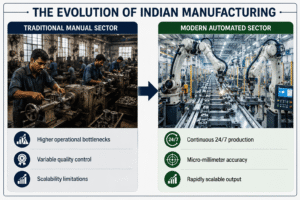
Modern industrial robots are far more versatile, communicative, and affordable than their predecessors. Today’s manufacturing units utilize advanced artifical intelligence, predictive maintenance software, and highly sensitive vision systems. Consequently, machines can easily execute complex tasks with minimal human intervention. According to recent industrial data from the International Federation of Robotics (IFR), India ranks among the world’s fastest-growing markets for industrial robot installations. This clear trend proves that local business owners are quickly recognizing the long-term economic advantages of upgrading their legacy infrastructure.
Key Drivers of the Robotic Revolution in Indian Factories
Several critical microeconomic and macroeconomic factors are accelerating the widespread adoption of robotic automation in manufacturing across the country:
- The Quest for Flawless Precision and Standardization: Manual assembly lines are inherently prone to human fatigue, which naturally causes subtle deviations in product quality. In sharp contrast, robotic systems execute identical physical movements continuously with micro-millimeter accuracy, ensuring that every single item off the assembly line meets exact specifications.
- Mitigating Rising Labor Pressures and Skill Deficits: While India boasts an incredibly vast labor pool, finding highly specialized, consistent technical skills for dangerous or highly repetitive processes remains an operational challenge. Automated hardware fills these critical gaps seamlessly without requiring breaks or shifting schedules.
- Optimizing Long-Term Operational Expenses: While the upfront deployment cost of high-end machinery requires planning, the long-term return on investment (ROI) is undeniable. Automated machinery drastically reduces raw material waste, minimizes costly scrap, and optimizes power consumption on the factory floor.
- Favorable Government Policies: Programs like the Production Linked Incentive (PLI) scheme have actively motivated domestic manufacturers to aggressively upgrade their facilities, encouraging local production facilities to align directly with international quality benchmarks.
Critical Applications of Robotic Automation in the Manufacturing Sector
To fully comprehend how robotic automation in manufacturing is restructuring the industry, we must take a close look at the specific shop-floor applications where these advanced machines excel:
1. High-Precision Material Handling and Warehousing
Moving heavy raw materials or delicate components manually through a facility can lead to costly material damage and severe workplace injuries. Advanced robotic arms equipped with specialized grippers handle heavy components effortlessly. Furthermore, the integration of Autonomous Mobile Robots (AMRs) and Automated Guided Vehicles (AGVs) allows companies to transport items safely across sprawling facility floors without any human intervention.
2. Advanced Robotic Welding Fixtures and Assembly Lines
The automotive and heavy engineering sectors in India rely immensely on top-tier welding precision. Automated welding systems handle Metal Inert Gas (MIG), Tungsten Inert Gas (TIG), and spot welding tasks flawlessly. By anchoring these arms to custom-engineered robotic welding fixtures, facilities ensure perfect part alignment every single time, totally eliminating structural defects.
3. Automated Fluid Dispensing Systems
Applying adhesives, sealants, lubricants, or specialized paints requires extreme control over liquid volume and flow speed. Automated fluid dispensing configurations apply materials evenly along highly intricate toolpaths. This eliminates fluid wastage and ensures strong seals, which is incredibly crucial for electronics packaging and automotive body manufacturing.
4. Foundry Automation Systems
Foundries are inherently hostile, high-temperature environments filled with hazardous dust and intense radiant heat. Deploying industrial machinery for strenuous processes like robotic fettling, core handling, and mold pouring protects human workers from extreme workplace dangers while maintaining an exceptionally steady production output.
Overcoming the Cost Barrier: The Power of Refurbished Industrial Robots
Despite the clear operational benefits, the initial capital required to purchase brand-new automated systems remains a massive roadblock for thousands of small and medium-sized enterprises (SMEs) across India. Fortunately, an innovative and highly sustainable financial solution has emerged: deploying premium refurbished industrial robots.
By opting for meticulously overhauled machinery from world-class global brands like ABB, Fanuc, and Kuka, business owners can slash their initial capital expenditure by up to 50% or 60% compared to buying brand-new hardware. This dramatic cost reduction dramatically lowers the barrier to entry, allowing mid-sized Indian workshops to enjoy the exact same high-precision performance, speed, and long-term durability as global manufacturing giants.
Realizing the Core Benefits: Why Indian Factories Must Automate
Implementing robotic automation in manufacturing directly addresses the most pressing operational pain points faced by traditional manufacturing setups:
- Exponential Boost in Throughput: Machines do not suffer from physical exhaustion or require shifts, allowing factories to run seamlessly 24/7 to fulfill urgent market orders.
- Drastic Reduction in Operational Waste: Automated precision means raw materials are utilized down to the absolute millimeter, driving down overhead costs.
- Maximum Workplace Safety: Moving humans away from dangerous, repetitive, or hazardous tasks like foundry pouring or heavy lifting significantly reduces costly workplace accidents and liability.
- Data-Driven Plant Optimization: Modern industrial arms generate deep operational datasets that integrate smoothly into enterprise resource planning platforms, allowing plant managers to track performance metrics in real time.
Strategic Services to Accelerate Your Automation Journey
Transitioning a traditional production plant into a high-yielding, automated powerhouse requires deep domain expertise and structured execution. At Mahajan Automation, we specialize in providing tailored, end-to-end industrial robotic systems that fit your precise operational needs and budget constraints. Our comprehensive suite of services includes:
- Premium Refurbished Robot Sales: We source, rigorously test, and supply top-tier used industrial hardware from leading global brands like Fanuc, Kuka, and ABB, offering maximum reliability at a fraction of the cost of new systems.
- Turnkey Robot Integration: Our expert engineers handle everything from site assessment and tool design to final installation, custom programming, and safety calibration on your floor.
- Robots on Rent: Minimize your financial risks by leveraging our flexible robot rental programs, allowing you to easily scale production for short-term contracts without major upfront expenditures.
- Genuine Spares & Dedicated Maintenance: Protect your production uptime with our extensive inventory of certified spare parts and proactive Annual Maintenance Contracts (AMCs).
Looking Ahead: The Future of the Indian Smart Factory
The ongoing transformation of India’s industrial landscape is just getting started. As we move further into the future, we will see an even deeper convergence of advanced software and rugged mechanical hardware. The integration of 5G connectivity, advanced edge computing, and cloud-connected digital twins will enable real-time synchronization between separate assembly lines located across different geographic areas.
Moreover, the rise of collaborative robots (cobots) will redefine the traditional shop-floor dynamic. Rather than replacing human workers, cobots work hand-in-hand with human operators, combining human problem-solving agility with mechanical precision and strength. Indian manufacturers who boldly adopt these scalable innovations today will undeniably capture major market share and lead the global industrial landscape tomorrow.
Elevate Your Production Efficiency with Mahajan Automation
Are you ready to eliminate operational bottlenecks, slash material waste, and skyrocket your facility’s daily output? You do not need an astronomical budget to introduce world-class automation to your facility floor.
Partner with India’s trusted automation integration specialists. Contact the engineering team at Mahajan Automation today to schedule an in-depth facility audit. Let us help you design a high-performance, cost-effective automation strategy tailored specifically to your business goals.
Frequently Asked Questions (FAQs)
Q1: Is robotic automation in manufacturing suitable for small-scale Indian enterprises?
Ans: Absolutely. With the widespread availability of high-quality refurbished robots and flexible robot rental programs, SMEs can integrate automation with a minimal initial capital layout, achieving an incredibly fast return on investment.
Q2: What is the average lifespan of a certified refurbished industrial robot?
Ans: When sourced from top-tier brands like Fanuc, ABB, or Kuka and maintained properly through regular servicing and quality spares, a certified refurbished robot can operate reliably for over 10 to 15 years.
Q3: How do robotic welding fixtures improve overall product quality?
Ans: Robotic welding fixtures hold components rigidly in the exact geometric position required. This completely eliminates part warping, shifting, or human alignment errors during the welding process, ensuring identical, high-strength welds every time.
Q4: Can industrial robots be reprogrammed for different manufacturing tasks later on?
Ans: Yes, one of the greatest advantages of industrial robotic arms is their incredible versatility. If your product line changes, the hardware can be easily reprogrammed, fitted with new end-of-arm tooling (grippers/torches), and redeployed for a completely different task.
Q5: How does Mahajan Automation ensure the reliability of its used robots?
Ans: Every single used robot in our inventory undergoes a rigorous, multi-point refurbishment process. We inspect, service, test, and calibrate each component to original OEM standards, and back our systems with a comprehensive warranty for total peace of mind.