
The race for industrial automation is accelerating at a breakneck pace. Modern manufacturing facilities face a continuous battle against rising labor costs, strict quality demands, and compressed production cycles. To maintain a competitive edge, incorporating robotics into your factory floor is no longer a luxury—it is an absolute necessity. However, when your engineering and financial teams sit down to map out the deployment, you will inevitably face a critical crossroads: New vs Refurbished Industrial Robots: Which One Should You Choose?
This decision impacts far more than your initial financial layout. It directly influences your long-term operational efficiency, maintenance schedules, factory floor adaptability, and return on investment (ROI). Brand-new automation setups offer the allure of cutting-edge software and zero operational hours. On the flip side, high-quality refurbished industrial robots provide a financially sensible alternative, unlocking robust automation at a fraction of the cost.
Choosing the wrong path can tie up capital or leave your production line saddled with unexpected compatibility bottlenecks. In this comprehensive guide, we will break down the structural, financial, and mechanical realities of both options. Ultimately, this will help you make a well-informed, data-backed choice for your facility.
Understanding the Contenders: New vs. Refurbished Automation Systems
Before evaluating technical specifications, it is vital to establish clear definitions of what you are investing in. The industrial robotics market has evolved dramatically, meaning the gap between new and pre-owned machinery is no longer as wide as it once was.
The New Industrial Robot Standard
A new industrial robot comes directly from original equipment manufacturers (OEMs) like FANUC, ABB, KUKA, or Yaskawa. It features the latest mechanical designs, energy-efficient motors, and next-generation control systems. When you buy new, you receive an untouched machine with a full manufacturer’s warranty, pristine documentation, and immediate access to the vendor’s direct technical support network.
What Safely Defines Refurbished Industrial Robots?
It is crucial to distinguish a certified refurbished robot from a used or “as-is” machine found on liquidation sites. Refurbished industrial robots are pre-owned robotic systems that have undergone a rigorous, structured overhaul. Industrial automation experts completely disassemble the mechanical arm, inspect it thoroughly, clean it, and rebuild it.
During this extensive engineering procedure, technicians swap out worn components, flush and replace specialized greases, change internal wiring harnesses, and overhaul the control cabin. The system is then calibrated back to its original factory specifications for precision and repeatability. Finally, it undergoes exhaustive testing under realistic payloads to ensure it performs reliably before it is deployed to your production facility.
Financial Analysis: Upfront Expenditures vs. Total Cost of Ownership (TCO)
For most production managers and financial officers, cost serves as the primary evaluation standard. Balancing short-term budget limits against long-term operational value requires a close look at the complete financial picture.
Capital Expenditure (CapEx) Advantages
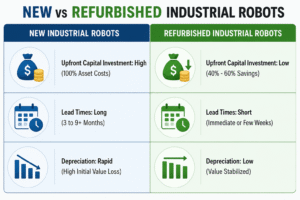
The initial procurement cost is where refurbished robotic systems shine brightest. On average, a thoroughly reconditioned and certified industrial robot costs 40% to 60% less than a brand-new counterpart with matching payload and reach attributes. According to data from the Association for Advancing Automation (A3), choosing certified pre-owned units slashes initial equipment outlays significantly.
For small-to-medium enterprises (SMEs) or facilities introducing automation for the first time, this massive cost reduction lowers the barrier to entry. Instead of purchasing a single new robotic workcell, an automated facility can often deploy two or three refurbished workcells for the exact same capital expenditure. This significantly boosts overall factory throughput from day one.
Return on Investment (ROI) and Depreciation Cycles
Because the upfront purchase price of refurbished industrial robots is substantially lower, the timeline to achieve full ROI is dramatically shortened. A new robotic system typically takes three to five years to break even when you factor in tooling, integration, and peripheral safety systems. A refurbished system frequently hits its break-even point within 12 to 18 months.
Furthermore, industrial machinery experiences its sharpest asset depreciation during its first few years of operation. By purchasing a certified refurbished unit, you let the previous owner absorb that initial drop in asset value, leaving you with a highly stable asset on your balance sheet.
Technical Performance: Repeatability, Software, and Lifespan
Beyond the accounting spreadsheet, a robot must perform perfectly on the factory floor. Let’s look at how new and reconditioned systems stack up regarding mechanical precision, software architecture, and overall longevity.
Path Precision and Mechanical Repeatability
A common misconception is that a refurbished robot arm won’t deliver the tight tolerances required for precise industrial manufacturing. However, high-quality industrial arms are built from rugged, heavy-duty structural castings designed to last for decades.
During a professional refurbishment process, internal gearboxes (such as RV reducers and harmonic drives) are carefully inspected. If backlash or play exceeds strict factory limits, these components are replaced or shimmed back to pristine status. As a result, a certified refurbished robot can easily match its original factory specifications—often maintaining an exceptional repeatability tolerance of ±0.02mm to ±0.05mm. This makes them perfectly suited for demanding applications like robotic arc welding, material handling, and palletizing.
Software Integration and Industry 4.0 Compatibility
This is the area where brand-new industrial robots hold a clear technical advantage. New machines come equipped with advanced control software, built-in cyber security protocols, and native connections for cloud analytics and Industrial Internet of Things (IIoT) platforms.
Older refurbished units may feature legacy software architectures. While they operate wonderfully for their intended tasks, connecting them to a modern, unified factory network can sometimes require extra communication gateways or PLC retrofits. However, a premier automation integrator can easily bridge this gap by upgrading the robot’s control system. This ensures it communicates perfectly via standard industrial protocols like EtherNet/IP, PROFINET, or OPC UA.
Lead Times and Deployment Velocity: Battling Supply Chain Bottlenecks
In modern manufacturing, time-to-market is everything. Missing a production window because your equipment is stuck in transit can cost your business lucrative contracts.
The Ongoing Reality of OEM Lead Times
Procuring a brand-new robot directly from an OEM can come with significant lead times. Depending on world supply chain conditions, component shortages, and global logistics, getting a new system delivered can take anywhere from 3 to 9+ months. If you need a highly customized configuration, that waiting period can stretch even further. If your factory floor needs to scale up quickly to fulfill a newly signed client contract, a multi-month delay simply isn’t an option.
Rapid Deployment Capabilities of Refurbished Systems
Conversely, refurbished industrial robots offer a massive advantage when it comes to deployment speed. These physical units are already built and sitting in the inventory of specialized automation providers. Once you finalize your workflow requirements, the robot undergoes its refurbishment cycle, custom programming, and tooling integration. It can often be shipped, anchored, and operational on your factory floor within a matter of weeks. This rapid turnaround lets you capitalize on sudden market opportunities and resolve production bottlenecks almost immediately.
Application Matching: Where to Deploy New vs. Refurbished Units
Not every application on your production floor demands the absolute pinnacle of cutting-edge robotic technology. Smart automation engineering relies on matching the right piece of machinery to the complexity of the specific task.
Ideal Use Cases for New Industrial Robots
- High-Speed Vision-Guided Electronics Assembly: Tasks that require real-time AI processing, ultra-high-speed SCARA movements, and sub-micron precision are best handled by brand-new systems.
- Collaborative Cleanroom Operations: Specialized medical, pharmaceutical, or semiconductor environments frequently require brand-new collaborative robots (cobots) with pristine, factory-certified cleanroom coatings.
- Complex Multi-Axis Sync Tracking: Advanced applications—such as continuous 3D laser profiling across moving conveyor paths—benefit greatly from the latest high-end OEM controllers.
Ideal Use Cases for Refurbished Industrial Robots
- Robust Material Handling and Machine Tending: Moving heavy parts between CNC machines or stamping presses relies on structural durability and consistent positioning—areas where refurbished heavy-payload arms excel.
- Industrial Arc and Spot Welding: Robotic welding relies heavily on structural repeatability and path consistency. A reconditioned six-axis articulated arm delivers flawless weld seams at a highly accessible price point.
- Palletizing, Packaging, and End-of-Line Logistics: Stacking boxes, loading pallets, and handling shipping containers are straightforward, repetitive tasks. They don’t require expensive, cutting-edge control software, making them ideal for budget-friendly refurbished units.
Environmental Sustainability and the Circular Economy
Modern corporate mandates look at more than just profitability; reducing your environmental footprint is now a core business objective. Integrating refurbished machinery into your automated facility directly supports global sustainability initiatives.
Manufacturing a brand-new industrial robot requires a significant amount of raw materials, rare earth elements, and energy-intensive smelting for steel and aluminum castings. Choosing refurbished industrial robots extends the operational lifecycle of perfectly sound industrial machinery, keeping heavy assets out of industrial scrap yards and significantly reducing e-waste.
By embracing this circular economy model, your facility dramatically lowers its scope 3 carbon emissions. This lets you meet strict corporate environmental goals while maintaining high productivity and a healthy bottom line.
The Critical Risk Mitigation Checklist
If you decide that a refurbished industrial robot is the right fit for your factory budget and operational goals, you must protect your investment. To ensure you avoid auction-house pitfalls and secure a reliable machine, always use this essential engineering checklist:
- Insist on Comprehensive Diagnostics: Never buy a machine without seeing a complete backlash analysis, axis-by-axis repeatability certification, and full software error logs.
- Verify Parts Availability: Choose common, widely supported models from major global brands (such as FANUC, ABB, KUKA, or Yaskawa). This ensures you can easily find replacement parts and support for the next 10 to 15 years.
- Examine the Engineering Team’s Expertise: Ensure your refurbishment vendor employs certified, factory-trained automation technicians who fully understand proper electrical, mechanical, and safety standards.
- Secure a Solid Warranty: A reputable refurbishment provider will back their workmanship by offering a comprehensive warranty on parts and labor, giving you peace of mind from day one.
Partner with Mahajan Automation for Industry-Leading Robotics Engineering
Navigating the complexities of factory automation requires an experienced, reliable partner. At Mahajan Automation, we don’t just sell machinery—we deliver completely engineered, turnkey automation solutions tailored to your unique production demands. Whether your workflow calls for the absolute latest advancements in brand-new robotic technology or the smart, cost-saving efficiency of precision-engineered refurbished industrial robots, our expert engineering team is here to guide you every step of the way.
We handle the entire automation lifecycle, including initial conceptual design, rigorous mechanical overhauls, advanced PLC programming, custom end-of-arm tooling (EOAT) development, on-site installation, and comprehensive preventative maintenance support.
Don’t let long OEM lead times or restrictive capital budgets stall your operational growth. Contact the industrial engineering experts at Mahajan Automation today. Let’s design a high-efficiency, reliable, and cost-effective robotic system that will scale your production and elevate your bottom line for years to come.
Frequently Asked Questions (Q&A)
Q1: What is the typical remaining lifespan of refurbished industrial robots?
When an industrial robot undergoes a comprehensive, professional refurbishment process, all major wear components, seals, and bearings are inspected or replaced. Because the rugged structural castings of major brands are incredibly durable, a properly reconditioned robot can easily provide an additional 10 to 15 years of reliable service, provided it receives standard preventative maintenance.
Q2: Can refurbished robots be integrated with my existing factory PLCs and automation equipment?
Yes, absolutely. Experienced automation integrators can configure the robot’s control system to communicate seamlessly with your modern factory equipment. By using standard industrial communication protocols like EtherNet/IP, PROFINET, or Modbus TCP, refurbished units can easily sync with your existing PLCs, HMI panels, and conveyor systems.
Q3: Is it difficult to find replacement parts for older refurbished robot models?
Not if you stick to major, industry-standard brands like FANUC, KUKA, Yaskawa, or ABB. These global manufacturers maintain vast component ecosystems, and third-party parts availability remains robust for decades. At Mahajan Automation, we carefully source and support widely used robot models, ensuring our clients have immediate access to spare parts and minimize any unexpected downtime.
Q4: How much money can my factory realistically save by opting for refurbished robotic workcells over new ones?
Generally, a certified refurbished robot arm alone costs 40% to 60% less than a brand-new model with equivalent payload and reach specs. When you look at the total integrated workcell (including safety fencing, custom end-of-arm tooling, and programming), companies typically see total project cost savings of 30% to 45%. This allows for a much quicker return on investment.
Q5: Do refurbished industrial robots come with a warranty?
Yes. While buying an “as-is” used robot from an auction carries significant risk, purchasing a certified refurbished system from a premier automation provider like Mahajan Automation includes a comprehensive parts and labor warranty. This ensures your investment is thoroughly protected against early mechanical or electrical issues.